October 14, 2019

#74: Excerpt From Updated Sweetbriar - Chief Seattle Plots Necessary Revenge

Herring House Village by Brenda Wilbee
Herring House, Duwamish River / Sketch by Brenda Wilbee

During this time, Seattle moved between residences on Elliott Bay and at Old Man House, where Angeline [Kick-i-som-lo] said he hunted elk with bow and arrow.
...  
- David M. Buerge in Chief Seattle and the Town That Took His Name

In the Moon of Swan Migration, a full decade before the Borens and Dennys took the Indian trail to Oregon, destination unknown, fifty-five-year-old Chief Seattle went to visit his second wife at her village near the Duwamish River mouth. He wanted to take their mid-grown sons hunting; his intention to find an elk for Kick-i-som-lo, his twenty-one-year-old daughter who lived with her two little girls at Old Man House, his primary residence. That he was devoted to his eldest went without saying. Today, in preparation for the hunt with his boys, however, he sat on the floor of the long communal deck of Herring House village, legs swinging off the edge, double-checking his arrowheads. He preferred bow and arrow over the Hudson’s Bay Company’s muzzle-loading rifle. Faster to load and silent.

The village ran in a line along the beach, most of the homes built on stilts to avoid the high tides, most with steep cedar-plank roofs. With white men now on the Nisqually Flats and Muckleshoot Prairie, they’d been able to trade for tools: the adze to split cedar into long thin planks; saws, hammers, and nails to build  framed homes.

“ʔi čəxʷ!” Hello!

Curley, Chief Seattle's brother
He looked out to the water in surprise and rare smile to see his little brother of the same mother but different father drive his dugout onto the beach—considered “little” because Chief Curley stood nearly a foot shorter than Seattle and fifteen years younger.

“ʔi čəxʷ! Haʔɬ sšudubicid?!” Seattle greeted. Hello, good to see you!

Named for his hair—rare but not unusual—forty-year-old Curley was primary chief of the Duwamish and lived not far away in Little Crossing Place on the east side of the Wulge. “I ran into Pat Kanim!”

Seattle’s scalp tingled. It had been six months since Owhi, war chief of the Yakima, had murdered his nephew. Almost daily he’d been waiting to hear from Pat Kanim, chief of the Snoqualmie and Snohomish—who lived closer to the mountains. 

“Stab kʷ(i) adsyəcəb?” What’s the news?

“He saw a band of Yakima come through the pass!”

Seattle’s mind leaped like lightning, the space between his thoughts crackled. “Is Owhi with them?” he asked, dropping half a dozen arrowheads into his soft doeskin pouch, taking the nearest stair off the deck and meeting Curley at one of the beach fires.

“No. But he says they’re headed down White River.”

“How many?” 

“Thirty men, maybe more.”

Thunder rumbled in Seattle’s head…a war party. “He must think me weak to send so small a flotilla.”

“Thirty men make a high blood price.”

He’d have every last one of them, and said as much.

His word was law. No one argued. No one wanted to. And not today.

With his straight legs and well-fed body, Seattle towered above everyone—not only in stature but in sheer force of will and experience. He used speed and surprise to bring down his enemies. Even the Haida had come to fear him, and their raids on the Wulge had long ago sputtered to an end. His use of language, rich with metaphor and music, inspired the brave, stirred imagination, braced the cowardly, rallied the weak. Muscular, deep chested, he could project his voice three-quarters of a mile and orate for an hour. On cold days, a mile. Today he called for warriors; they came out of nowhere. He chose two of the quickest and strongest to go upriver at once.

“I want to know exactly where they are, and if we have time to set a trap. Portage between the river’s curls. We’ll follow within the hour.” To Curley, he said, “We’ll ambush them at the Bend if we can.” To fifteen-year-old Jim, begging to go, he said, “I promised Kick-i-som-lo an elk. It’s up to you now.”

“If it wasn’t for her, I’d get to go.”

“Yes, opportunity ripened and I must revenge.”

Jim seized a rock and in mindless fury hurled it, accidentally catching a slave in the shoulder. The surprised old man screamed and fell to his knees, clutching his dislocated joint.

“Your temper,” said Seattle to Jim, “will be the end of you one day. But today you will go find the shaman.” He dismissed his ill-tempered son and ordered a Skokomish slave to bring Curley freshly steamed clams; and Curley dropped to a squat by the fire and greedily sucked down the hot meat with smacking lips. Within the hour, they pushed off, leaving Herring House in eight canoes, three warriors to each.
____

Seattle Sweetbriar, updated and illustrated, to be re-released 2020


June 17, 2019

#73: Forgiveness Intervenes

Phil, Heather, Blake
A single mother for years, people often asked, "How ever did you do it?” There was an assumption I did do it.

The kids are grown and gone and have kids themselves. Eight in fact, and more on the way. When I sold my house to down-size in 2012, I spent a lot of time going through old files and came across a folder of Heather’s school work. She was six when I left her dad, and she's suffered the most. Because she gave me no trouble, I tended to leave her to herself. There were so many other things to do.

One of my most painful memories of her childhood is when she broke her knee. She was out riding her bike a few blocks from home when a neighbor kid plowed right into her, dropping her straight down on her knee. Somehow she managed to get the bike and herself home and into my bed. She instructed her little brothers to pack her knee with ice and waited until I got home.

I was at a writers conference an hour away. No cell phones then. When I returned, she’d been in pretty brutal pain for hours, watching her knee swell despite the ice and aspirin. I bundled her into the car and over to emergency, where they splinted her leg and suggested a surgeon. Amidst my sea of guilt, I was thunderstruck at how stoic and smart she’d been.

Yet I couldn’t be everywhere—physically, emotionally. I was far away in world of unrelenting stress and juggling the impossible. Balls dropped and rolled away. I was always scrambling after them and starting again. This was my reality. And unfortunately hers.

Here's a letter from that file. Heather had been asked to write it.
“Are you wondering why I am writing you a letter? It’s because Mrs. Morris is making us. We have to do this every week on Friday and it has to be returned, signed by you. If we bring it back on Monday we get 25 points. For every day it’s late, we lose 3 points. I know you hate reading and signing letters...”
She’s referring to the inundation of paper work I constantly received from the schools for all three of my children; everything had to be reviewed and signed and returned and, yes, I hated it. The clutter of it all in my head—while struggling to get the bills paid and food on the table and attend all the other things needing attention—was too much. I didn’t mind reading the material; it was the constant of signing and keeping track and reporting to the teachers that I minded. Why all the falderal? When I was a kid, we did our homework and that was that. None of this running back and forth between home and school. As a kid, it would have driven me nuts. As a mother?

But reading Heather’s letter years later, away from the pressing needs of yesterday, I realize my irritation had been hard on her. Not only did she have the responsibility of orchestrating the paperwork, her grade depended on it—she had my resistance. Stoically, she'd soldiered on. I'm bothered by this.

A second realization. “...it’s not my fault,” she'd added. She tried so hard not to burden me. This really bothers me.

But if this first letter bothered me, it was the one dated October 9, 1989, that upset me. In the middle of her narrative, Heather wrote:
“Now, I’m supposed to tell you what I’m doing this weekend. I’m going to Dad’s. I don’t think you care what we do.”
Right in the solar plexus. I did care. But the weekend reports with Dad triggered rage, and disgust. My children’s lack of care was so profound--and I so helpless--that early on I’d begun to steel myself and eventually trained myself to remain passive when hearing about it. For instance, in the early days they had to sleep in urine-soaked sleeping bags. They came home reeking.  Their necks were dirty. Their hair uncombed. In later years my habit was to simply listen, to remain disengaged from their lives outside my sphere. Today I realize that Heather interpreted my passivity as “not caring.” I was remiss and this bothers me.

So to answer everyone’s question, “How did you ever do it?” I here and now answer, "I didn’t. I failed."

But here’s the twist. Heather and her brothers seem to have forgiven my faults and negligence. And if ever I doubted it, a letter from Phil is the pile alongside Heather's. Apparently some huge crisis occurred in March 1999. I have no memory, there were so many. This must have been a doozy though. Phil was 21. He writes:
"I had no idea this was going on, you say this started on the 30th? I have already prayed for you, and prayed again. Mum, I don't want you to scare me like that again. You have been so strong for all of us our whole lives. I am not telling you to be strong now, because I can understand, no, I can’t, but I simply ask that you allow us to be strong for you now. Tears run down my face as I hear your distress, think about the beautiful things. Any year now you may be holding a grandchild in your arms. You can teach them to love themselves as you have taught me. Sending my children to grandma’s house is something I have dreamed of my whole life, to let them experience the love and encouragement I was so fortunate to have….Please always remember that I love you and that I, we, will be strong for you…"
Their whole lives, they watched me lurch from one upheaval to the next while I struggled with poverty, poor health, and all the attendant worries that come with any kind of parenting. My faults speak for themselves. But it seems forgiveness intervenes.

April 10, 2019

#72 - Uncovering The Easter Bunny

The C Shop
WHEN I WAS A KID, I had no idea how the Easter Bunny came by all those candied eggs. I was edging into old and wearing my first pair of bifocals when I stumbled onto the truth.

The C Shop of Birch Bay, WA.

December 2006 I moved uphill from Birch Bay's iconoclastic C Shop, housed in the old Birch Bay Resort of 1904. Owned by two retired school teachers, Patricia and Patrick Alesee,  the ShePat and HePat keep busy during Lent to fill the Easter Bunny's baskets, who for years has been hippity-hopping those baskets right to your own front door.

The Pats and I became friends and about the end of January, and the ShePat started making noises about not getting the lead out of her feet. She was officially a week behind the "big start," an intense ten-week, round-the-clock, labor intensive effort to get all her chocolate bunnies, roosters, teddy bears, frogs, and chickies... ready for you know who.

Brenda Wilbee making candyI got in from grocery shopping one day in early February to a phone message: Pat had the lead out of her toes at last and needed to make 25 boxes of mint daisies. Did I want to come down and do the centers?

Patricia's very famous "white chocolate" mint daisies actually go out all over the county and country year round, but first someone has to make the yellow centers where the mint lives and permeates the flower. In 2008, that would be me. So here's the "inside" scooby-doo from The C Shop to you on how to make mint daisies.

Putting in the candy centers
First you have to use a lollypop stick--without the lollypop--to transfer very warm "white chocolate" (that's really really yellow and very very minty) into the daisy centers of the dozen-to-a-sheet mold. You work beside a heater to keep your fingers hot, the chocolate smooth, and you make sure to drop a perfectly round circle--no spilling or sloppy stuff. If you twitch? Wait for it to cool, pop it out, and start again. I, just so you know, did not have to do that too often. Just sayin'.

Filling candy molds
Now someone's go to fill the molds. That would be the ShePat. She has a dispenser that squirts "white chocolate" on top of the yellow centers, filling in the petals in the exact same way teenagers working at Dairy Queen squirt soft ice cream into cones. Squirt, squirt, squirt, very fast, very impressive.

Pat Alesse boxing daisy mints
Then she gently whacks the mold against a table top, whack, whack, whack, another whack, turning and jiggling the chocolate down into the flower pattern.

Now into the freezer. Sheet after sheet to harden. Rows upon row. Shelves of them. Centers all made by me. Thank you very much.

Hardened, we pop them out and box. Thirty to a box.

Now here's some really good news if you're hungry. No longer do you have to wait for the Easter Bunny! Today you can order your own box of daisy mints--

--along with all kinds of other Easter candy. 


Oh, yea, nearly forgot. Not only is the C Shop where the Easter Bunny gets his haul, the C Shop is where the Easter Bunny lives! See him here with his Honey Bunny? And  now I know, and now you know too!

Easter Bunny and His Honey, the C Shop

February 19, 2019

#71 - On Meeting God

Spring 1969, Brenda Wilbee
June 1968 - 16 years old
WHILE SHARING one of my stories with a friend, she interrupted, “And you still believe in God?”

Belief is my story. A story that began the day I died—August 3, 1969.

I was seventeen years old that sunny Sunday just outside Vancouver, British Columbia, Canada. The Chicago Cubs were about to defeat the San Diego Padres, Elvis Presley was playing in Las Vegas; and two weeks before we’d all watched Neil Armstrong and Buzz Aldrin make their historic moonwalk. Nothing in my own world suggested anything out of the ordinary. True, my asthma was troublesome. But my parents had left me in care of my uncle, a doctor, before taking off for short-term mission work. That sunny Sunday I woke to the usual racket in the house, my five cousins stirring, Auntie Anne hollering to hurry up, breakfast was ready. I showed up but begged off church. I just couldn’t breathe.

I retreated to an upstairs’ bedroom. My lungs began to tighten. I struggled to draw air and was grateful to hear the car pull up just after noon. Car doors slammed, hinges squealed. Five kids tumbled through the front door and up the half flight of stairs. My uncle came to check on me and with a worried look told eight-year-old Patti to get me a spoon. “A tablespoon,” he told me, handing me a bottle before leaving on a house call.

Almost immediately I was in trouble. Tight lungs tightened, an iron grip climbing into my throat, leaving only a wee sliver of airway. I couldn’t call for help, and in mounting panic I focused on making each tiny breath count. Vision closed in. Sound came to me as though submerged. Patti popped her head around the corner. Freckles jumped in her face and she fled. Within seconds, my aunt arrived. I lost grip of the bedpost, and Auntie Anne struggled to keep me sitting while I hung to life by a thread of air, and in full-blown panic.

A funny thing, time. Ticking away, a steady beat but petering out as the mind whirls in a kaleidoscope of tumbling thought and fear and madness for oxygen, each belabored breath a countdown. Sharp, twinkling pricks began to plague, and I felt my body to be a universe of stars blinking painfully out one by one and in rapid clusters, and I knew myself to be dying.

Uncle Stan returned. I had no sense of sound, though I felt him heft me into his arms. I flopped like a thing already dead, legs swinging, banging into the doorjamb, down the stairs, out to the car. Somehow I was sitting on Auntie Anne’s lap in the back seat. I could see the leaves of the trees, tiny and bright, ever so green and oh-so-lovely while we rocketed downhill on the pitted, gravel road of 6th Avenue to 56th Street, the main drag out of town. How can I see them? I didn’t have my glasses.

Moments later we pulled into my uncle’s office on 56th. I felt a sting and jab to my thigh. Epinephrine? Fear surged, each breath cruel disappointment. Don’t let me die! Please, dear God, don’t let me die! But I was dying. No matter my begging, I wasn’t going to make it to the hospital. Was there sunlight in heaven? Do trees grow? Did birds sing? Could I walk a beach with waves at my ankles? Don't let me die!

Yea, through the valley of the shadow of death, I will fear no evil.

A verse surfaced in the storm—a buoy on waves. I will fear no evil. I will fear no evil. We approached the George Massey tunnel that ran under the Fraser River, the hospital ten minutes out. Sunlight rippled through the stretch of overhead slats. I will fear no evil. We descended into the yawning cavern. I will fear no evil. I fear evil! I was going to die in that tunnel! In a rising tsunami of terror, foot braced beneath the front seat, I pushed up for a last desperate breath. For thou art with me, thy rod and thy staff they comfort me. Next verse surfacing, we shot into the tunnel. Peace (all pain and panic gone) swept me into the darkness.

Inside George Massey Tunnel
George Massey Tunnel
“I think we just lost her,” said my aunt. My uncle whirled, face white.

How can I hear Auntie Anne if I’m dead? How can I see my uncle’s face?

A light began to grow in the distance. I emerged from darkness into a butter-yellow brilliance that held in its core a more brilliant light yet, white, more dense but transparent, luminous and shimmering. No one had to introduce us—and for a moment I stood surprised by the radiating love of God.

Over the years, I’ve struggled to find words to name what I felt in those brief moments. Bliss, harmony, a oneness with the source—more than this. Serenity, connection, grace, inclusion, love. More still. A holy wonder far outside the gamut of love we so poorly know and experience here.

But I was to go back.

I don’t understand.

You have a purpose to fulfill.

I don’t want to go back. I don’t want to die again. I didn’t. I wasn’t a fan of the process.

You’ll go back to Abundant Life.

Have I been healed?

You have a purpose.
EMERGENCY sign
Richmond Hospital
The Light of God gave way to sunlight, and I saw large red letters spelling EMERGENCY, bobbing ahead at an angle impossible to see from the backseat of a car. I floated up through the roof, the letters below me. I trailed behind like a kite attached to the bumper—though I had no sensation of speed. The car wheeled left, juddered to a stop at the hospital curb. I swung pleasantly around to a different position as if by centrifugal force, ending up in front of the car, facing it, though much higher up and no longer tethered. I hovered like a hummingbird. My uncle jumped out, ran around behind, and came up the other side to pull me from my aunt’s arms. He couldn’t get me out. A flurry of hospital staff appeared. Curiously, I watched the frenetic attempts. No one seemed to understand my foot was stuck, wedged beneath the front seat—jammed when I’d pushed up for air I couldn’t find.

“My foot is stuck!” I hollered down.

The anxious staff circled. Someone else tried. I shouted again, this time using my hands to megaphone. I had no hands—but I did. I could move them, I could feel them on my cheeks. I had no cheeks. I looked down. No body. A void, without shape or form but curiously alive. My thoughts whirled and a thousand things flitted through my mind. But the commotion below unnerved me.

"MY FOOT! MY FOOT IS STUCK!”

“Her foot is stuck,” said Auntie Anne.

They pulled me loose and lay me on the gurney, looking like nothing more than a heap of summer clothes. But then I was back—a brutal, horrifying shock. One minute floating, free, the next incarcerated inside my ribcage, trapped by skin and bone. Claustrophobic, crammed into close quarters, confined, no escape—and again in a roaring thrum of terror and madness for air.

Breathing eventually returned, and I recovered. But I had not been healed.

Summer over, my family returned to the Midwest where we lived at the time. I spent more days out of school than in, and again was in the hospital. Late October, family friends suggested I go live with them in Arizona. My mother took me down, enrolled me in high school, and on Veterans Day, November 1969, put my fragile life in the care of a Christian doctor in nearby Scottsdale, a Young Life leader at Scottsdale High.

She waited for me in the waiting room. More than hour later I wobbled out, pale and shattered and unable to speak. I still don’t speak of what happened. In three months’ time I’d gone from the gates of heaven to the gates of hell. Life derailed—a different trajectory, and I bumbled along as happens to the abused.

So much for Abundant Life. Yet Jesus warned of thieves who come to steal and kill and destroy. He told us, too, He’d come to give life—abundantly. I was confused. Fifty years later, I understand. God resurrects our lives and restores our souls, over and over and over again, and as many times as it takes. The summation reveals abundance too easily missed.

“So you still believe in God?”

I do. He is. I met him, and I understand better than others of His love. Perhaps this is my purpose for which I’ve been sent back, to simply bear witness to Love Divine, a holy wonder outside the gamut of love we so poorly know and experience. Love so sacred it pulls us through the profane.

Anne and Stan Wilbee
Mercy et merci.____  
Two years ago I asked Uncle Stan and Auntie Anne what they remembered of that day so long ago, on August 3, 1969. My aunt says she doubts that she'd ever have said, "I think we just lost her." 
"I wasn't going to give up hope," she told me. Yet I clearly remember and wrote about it within days of the event. 
Uncle Stan said she sang from the tunnel to the hospital, and I suspect this was the music I heard as I slipped from darkness into Light. My aunt has the voice of angels and I like to think they sang together, seeing me safely through the valley of the shadow of death and back.
I am grateful that neither gave up. 
NOTE: While the medical profession prefers to call experiences like mine "near death experiences," many of us prefer "back from death." We've gone through the process of death and might as well name it. Interestingly, scientists are beginning to understand we don't really come back; we remain different, one of the most documented is our inability to wear watches. We kill batteries, our electrical circuits taking a hit. Furthermore, how we die also affects how we come back and what we're like. Death alters us in ways science has not yet come to terms with.

February 06, 2019

#70 - A Little Girl and Her Dad

Ski hill at Laurentian Lodge, St. Agathe, Quebec, Canada | 1963

“How about one last toboggan ride, Brenda, before we call it a day?”

Winter 1963, we lived at Laurentian Lodge, an Intervarsity Christian Fellowship ski resort seventy miles north of Montreal. College kids came up on the weekends. Mum cooked. Dad ran the ski hill and other things. I was ten years old, and in the mountains of French Canada night came on quickly. To go for one last ride with my father before tromping down to the lodge was all a little girl like me could ask for. Yes, yes! I hopped up and down on toes gone cold. He looped the toboggan rope around the towline in an easy slipknot, and I scrambled aboard the aluminum sleigh, grasped him around the middle, and waited for the jerk. There it was, we were moving, and I pressed my cheek against Dad’s cold woolen jacket.

It wasn’t a smooth ride up. The toboggan lurched, slacked, then jerked into motion. I fell into the rhythm of Dad’s arms stretching and pulling in, and I heard his occasional grunt more by the vibrations coming through his jacket than with my ears. The forest fell away to the right as we ascended, the evergreens dark and snowy white in the gathering gray, the larch and elm skeletal. I breathed and shivered and hung on tight, and I smiled in the sheer pleasure at the sensation of the snow beneath me.

“John!” Dad hollered, lifting an arm to wave at Mr. Hardy skiing downhill past us. “This’ll have to be your last run.” Mr. Hardy nodded and whizzed on by. The toboggan gave a lunge, throwing me back. “Daddy!” I shrieked.

He threw back an arm to snag me but missed, and the snow gave a snatch and flung me into its lap, belly down. I pulled a mitten off to dab at the snow in my eyes, then quickly stuffed my frozen hand back into its icy cocoon. It was really cold out. I clambered to my feet and peered uphill, stomping a bit to try and dull the burn in my toes.

Gray shadows crept over the hillside, the forest-green trees bruising into black, the other trees disappearing. Lamplight from the towrope posts glared down; at the bottom of the hill, where the machine shed stood, the last few colors of the day remained. All around, however, the sky closed in. I could feel the air shift into deep freeze.

Seven to ten poles lined the trail, each with a pulley three-quarters of the way up, with the towline feeding from one to the other. I watched the rope loop, pulley to pulley, on its way back down the mountainside to the shed where, inside, an immense machine kept the hefty cable circling, sending it back up to me. It circled past at my waist, and I cupped my hand around it to feel the heft slip through my palm. I could still get to the top, I realized, and flung myself belly first over the rope and grabbed on, expecting a wobble and slow crawl. But the frozen snow on my mitts let the rope slide on. I chewed at the ice clumps, spit them out, fur in my mouth. I tried again. This time I caught and, rope slithering beneath me, started sliding up to where Dad would be waiting.

“Get out of the way!”

I looked up. Dad was plunging downhill straight at me! I rolled, spinning sideways. I hurried to my feet, but the snow was soft and I floundered. Dad tore past, toque flying. What in the world? 

I looked uphill and gaped, even as I heard the crunch and ping of the metal toboggan high up. There it was, shiny in the lamplight. It hadn’t come loose but was riding back downhill, riding over each of the pulleys, its cheap metal twisting and buckling, dislodging the rope, and I crawled in disbelief from the deep snow onto the beaten path just as the contorted toboggan hit the post nearest me, metal screaming as it slammed into the pulley. The rope bounced out and with a whoosh through the air, landed at my feet with a thud. Overhead, the toboggan continued its steady course, the tin of it pinging and screeching, more rope crashing through the air and dropping. What if it went through the window into the machine shed?

At the bottom, Mr. Hardy frantically clawed at his feet, trying to kick aside his skis so he could get in and flip the switch. I snatched up my father’s toque and ran after him. “You lost your toque!” I hollered, slipping, standing, sliding again, stunned by the speed at which everything was happening. A quiet, slow world thrown into chaos.

One more pole to go before the toboggan rammed through the open window of the shed—then what?

I watched in disbelief as Dad, going too fast to stop, smacked right into the building, bounced, caught himself, then right-angled into the door. He stumbled over Mr. Hardy, disappeared. And then…suddenly…quiet.

I descended down into the stillness, darkness pressing in and stars coming out. Outside the shed, the twisted toboggan hung in the air, glistening in the eerie light, so mangled it was beyond recognition. A fantastical piece of tinfoil.

“Daddy?” I stepped into the shed. His back was to me on the other side of the ginormous engine with its fan belts and knobs, his elbows resting on the open window that fed the rope in and back out. He turned and I saw weariness play across his eyes. He smiled, though. Blue eyes, marble blue in the cold light.

"Why don’t you go down to the kitchen?” he suggested. “Help Mum with supper. We’re going to be here a bit.”

I offered his toque. “What happened?”

“The knot froze.” He chuckled softly. “Looks like we're going to have to fix this mess.” He laughed again with an off-hand phooey and took his hat and patted it down around his ears.

“Do you have to do it now? It's so cold."

“It might snow tonight. Or ice over. Best do it now. By morning, it might be too late.” He tucked his head back through the window and leaned, twisting his neck to better see the toboggan. “So much for my slipknot,” he told Mr. Hardy with another chuckle. To me, he said, “It’s getting too cold. You better go on.”

I pulled a hand out and sucked on my stinging fingers. The warmth made it worse. I shoved my hand back into the mitt. I walked to the door and looked down to the lodge where I knew my mother and sisters were setting the tables. On Friday nights Mum made the visiting college kids a dinner of roast beef and potatoes, with peaches for dessert. My sisters and I had to make sure the peaches were dished out with their round sides up. “They’re more likely to eat them,” Mum told us.

“Do I have to?” I asked Dad.

“No.”

He and Mr. Hardy took the ladder from a corner. I scrunched up against the doorjamb to let them pass, then followed after them, shivering, chin bouncing.

How can he stand it? I wondered, watching my father set the extended ladder against the first post, give it a shake, then start to mount. He had to disengage the mashed toboggan before attempting anything else.

He and Mr. Hardy set to work and I huddled near the shed, hiding from the wind. Constantly I banged my feet against each other; sometimes I turned and kicked them into the building. The bright overhead light looked yellow and warm and I slid down the wall to sit in the pool of butter. The cold seeped into my bum like tiny ice picks. What was left of the toboggan finally fell with a puff. Its distorted shape scared me and I stood up, and stepped away.

Dad climbed down the ladder. He and Mr. Hardy moved to the second pole, looking strangely naked without its rope. Mr. Hardy helped Dad heave the towline onto his shoulder and up he went, ladder rattling. Balanced on a high rung and leaning against the post, he struggled with bare hands to lift the rope back into the pulley. Gusts of white fog escaped his lips as he labored, and I saw him wince as the frozen rope dug into his shaking hands.

Tresa Wilbee Goodfellow, on flying saucer Winter 1963, Quebec, Canada
Tresa On Saucer, Me On Top
How can he endure it? I wondered again, and looked longingly down to the lodge where its small windows cast wee squares of light into a world gone black. Oh to be home, I thought. To shed my coat and boots, my mittens and toque, to stand over the furnace grate, four feet by four feet, and listen to the icicles melt off me and sizzle into the fire below. Oh that I was there.

My stomach hurt from shivering, I banged my toes into the ground, and banged again. Incessantly. I forced myself to look away from the warmth of home and focused instead on Dad’s face. I could see it clearly in the lamplight that shone from each post, a face haloed by night. I winced with each grimace he made.

Determined to stay, I hopped foot to foot and up and down while Dad and Mr. Hardy took turns. Once Dad caught my eye and smiled. I tried to smile back. My cheeks wouldn’t move. I tried again, and shivered some more. Slowly up the mountain we pushed, the night stealing in darker and colder. Up to the next pole. Up to the next. I wanted to cry, I was that cold. Yet on and on they worked, Dad and Mr. Hardy. And me.

As night set in for real, ice began to sheet the ground. They sent me back to the shed for a hatchet. I was glad of the task. When I gave it to Mr. Hardy, he said, “This is no job for a girl!”

“Don’t chop the rope,” I told him.

“That’s your job,” he said. “To make sure I don’t.”

We were almost there! Two more poles to go!

But Dad and Mr. Hardy headed straight for the final post. Dad groaned as he fought to stretch what was left of the rope into place. I feared he'd lose grip and fling himself backward, off the ladder. Or teeter sideways. He didn't.

But they weren't done. Not yet. There was that one last post, one down from us. We backtracked. The rope had little play. Brute strength would be needed to wrangle it up and over the pulley. By now, I was without pain. No stinging burn in my fingers or feet, no shivers. I lifted my arms woodenly, bent over at the waist, knocked them against my legs. I checked to see if my feet were still there. They were, which almost surprised me.

“Finished,” my father called down.

Mr. Hardy tossed his hat up. I watched it spiral lazily down. Watched him catch it and put it back on.

I tried to help carry the ladder back down but couldn’t keep the pace. Instead I slipped along behind them, the newly formed ice catching my boots against the holes they'd gouged with each step. At the shed, Dad and Mr. Hardy put the ladder back in its corner.

“Want a ride down to the lodge?” Dad asked, snagging another toboggan and flipping off the lights. I must have nodded.

Outside the night was velvet—and filled with moonlight and stars. Dad dropped the sled onto the snow. I was so numb I couldn’t bend. “I can’t sit down, Daddy.”

He and Mr. Hardy helped me.

Laurentian Lodge, St. Agathe, Quebec, Canada  |   1963“Ready?”

"Yes."

Dad took the line in hand and I waited for the jerk and momentum, then settled in, happy with the sensation of riding over the undulating snow, slipping this way and that on the hilly descent, watching the window light of the lodge expand as we approached, listening to Dad and Mr. Hardy talk in the wind. A snowflake. Another. And another. I stuck out my tongue to catch them.

Down the hill we slithered. The wind picked up. The flakes thickened, fluffing up in front of us. The windows grew large enough to see the tables indoors, surrounded by cheerful skiers nursing mugs of hot cocoa, their peaches gone, the bowls empty.

A whisper in my ear. I felt Daddy lift me.

“She’s frozen through,” I heard him tell Mr. Hardy.

I hardly remember sitting on the four-by-four-foot grate, heat leaping up at me. I hardly remember anything that followed. Nothing, actually. Only that I had stuck it out. I had not abandoned my father. A sense of euphoria overwhelmed me.

Many years have passed since that cold, snowy night in the Laurentian Mountains of French Canada. Yet I often go back, the memory as crisp and clear as the night. A little girl in love with her father, and so full of wonder at how he could laugh at any upset—and always make it right.
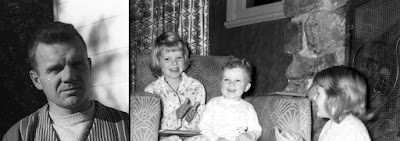
Roy Wilbee | Brenda, Tim, Linda Wilbee 1963
Roy Wilbee  |   Brenda, Tim, Linda Wilbee 1963


January 05, 2019

Epiphany: Resistance to the Empire

The Adoration of the Magi by Edward Burne-Jones, 1904
__________________________
Before they went to Bethlehem, the wise men had a meeting with Herod. “I have a problem,” Herod explained to them, “and I need your help. I need to find this child. I suspect he’s somewhere near Bethlehem, so I need you to ask around, use your sources, follow your star — then report back to me...
Throughout human history, individuals and institutions have had to make difficult and risky decisions in response to unjust directives—especially those directives framed as required cooperation “for the good of the country.”
"When The Wise Men Refused to Collaborate With The Empire"
by Kate Jones Calone /
click for article in Sojourners Magazine 


__________________________

Donald Trump and Pat Robertson
"People who revolt against Trump
Are Revolting Against God"
-- Pat Robertson --
On January 6 we celebrate Epiphany, the day the wise men of old finally found Jesus. We all know the story, three men on camels bearing gold, frankincense, and myrrh in search of a "newborn king." King Herod told them to come back to the palace with news of the baby's whereabouts so "he too could go and worship him." The wise men chose instead to take another road home, and in a dream God warned Joseph to flee with Mary and the baby for another country. Herod in his rage slaughtered every baby in Judea under two years old.

On this day of Epiphany, 2019, I approach the new year with trepidation and some fear because I find myself at odds with many of the people who like to tell this story. They don't see a disconnect between their admiration of three wise men and a hunted refugee family...and what's going on around us.

John Moore's Viral picture of Guatemalan Girl
John Moore's Viral picture
click for full story 
The grown-up teachings of this refugee infant by necessity seems to pit me against the majority [PEW Report] of evangelical Christians (81%) and nearly half (45%) of all Catholics who find in our American "King Herod" a savior--a self-made god who markets an end to abortion, punishment of gays, dehumanization of the transgendered, a demigod who mocks the disabled, promotes misogyny, agitates for violence, denies civil rights, supports voter suppression, brags about sexual violation, covers up promiscuity, flaunts adultery, bullies the abused, denigrates war heroes, lies every day, ignores his advisors, fires his smartest, meets dictators in secret, admires the world's scariest leader, Kim Jong-un--and separates thousands of children from their parents to secret them away in tent camps, cut off from love with no blankie, no teddy bear, at risk for physical abuse, sexual assault...and death. In short, everything Jesus came to refute. And, like Herod in "one of the most terrible accounts in Scripture [Calone, Sojourners]," the U.S. president lies to those not wise enough to see through his words, "Follow me and I too will worship Jesus." And like Herod he sacrifices thousands of children to build his Empire and suit his agenda.

Trump Mocking Disabled Reporter
click for full story
For two years I've watched and wondered, head spinning, sick to my stomach. And yet this chunky percentage of American Catholics and evangelicals do not sway but stand firm, intractable, seemingly comfortable with the cruelty, quick to defend, calling the narcissistic divine. Pat Robertson of the religious right preaches that any opposition to Trump is opposition to God. Franklin Graham tells Jimmy Carter that God  would kill gays, not marry them. In an interview with the Washington Post, Jerry Falwell said impoverished citizens offer little to society. "A poor person never gave anyone a job. A poor person never gave anybody charity." My head spins. Calling evil good, these men and their followers have come to prefer loyalty to the Empire over Jesus and his teachings. Loyalty to the Empire is more important than grace and mercy and risk and vulnerability. More important than love.

And so I approach 2019 with trepidation. I find myself in bewildered disagreement with those who once told me in that little Baptist church that "Jesus loves the little children of the world. Red, brown, yellow, black, and white, they are precious in his sight." They no longer teach this. Jesus is more selective now.

So despite my trepedation and, yes, fear, I am driven to resist the majority precisely because I believed them when they told me Jesus loves the little children of the world. I believe, too, he loves the adults they become--this I know 'For the Bible Tells Me So.' All of them. All of us. All around the world. Red, brown, yellow, black, and white. Poor, sick, starving, lost, and mocked. Frightened, scapegoated, disdained. South of the border, north of the border. All around the world. Bruce Larson of University Presbyterian Church in Seattle, WA, once said, "If you want to find God, go to the poor. They're the folks he likes to hang out with." I can't find God in what passes for Christianity in 2018.

So this January 6 is my own personal day of Epiphany. Jesus tells me to give the coat off my back, walk the second mile, turn the other cheek, feed his sheep, sell all my goods and give to the poor, to suffer the little children to come unto me, and "to act justly and love mercy" [Micah 6:8 NIV]. I am therefore compelled to resist evangelical leaders and their followers in their unabashed scramble for self-preservation and power at enormous cost to millions and the abandonment and condemnation of those God loves best.

Ironically, it's not the Empire that frightens me. I confess, it's the evangelical majority who support it.
________________
It’s abundantly clear that Jesus was a disrupter. . . Again and again, he reminds us that we’re not called to defend the institution but to promote a Kingdom in which the marginalized flourish and the forgotten are raised up.
"Churches Must Address the Toxic Residue of Elitism"
by Elizabeth Evans | click for article in Sojourner, 9/28/2018 

December 09, 2018

Born To Die, A Christmas Gift

December 10, 1957, my dead sister was born. She'd be 61 now, and each year she is a part of my Christmas Advent—as surely as the Christ Child of so long ago. For it was her life and death that put me in the front row seat with a view into eternity and first-hand experience with the grace of God.
______________________________________________

Heather Wilbee, Christmas 1959
She’d been born to die, Heather, a Christmas gift wrapped in grief. The year, 1957. Me, six. My mother returned from the hospital without my baby sister. My father explained. Heather had been born with a hole in heart and was not expected to live. He lifted me into my high yellow chair for supper and scooted me in. He did the same for Linda and Tresa. Seven, six, and five, me in the middle, I stared into the night and at our reflections in the large window on the other side of the table, wondering if the glass might fall in from the weight of sadness pressing against the house. Unable to eat, I pushed the food around on my plate. Dad cornered off some mashed potatoes. "Eat this much and you can be excused.

“Leave her be,” said my mother and I burst into tears.

But it was the grief, like sunlight through stained glass, which made Heather’s fragile life so lovely. She stayed with us for three years and how we loved her, my other sisters and I.

Wilbee sisters, 1961
The first eighteen months of her life we only knew her through hushed whispers and the occasional trip home. But when Mum and Dad brought her home for good—after her second open-heart surgery and not expected to survive the trip—one look at this frail little sister, so weak and so blue, and looking for all the world like me, my terrible grief eclipsed into magical wonder. God had hung a smile from the stars.

Heather Wilbee, 1960
For a long time we were not allowed into our parents’ room where Dad set up Heather’s crib under an oxygen tent. Exceptions were made if we donned surgical masks and scrubbed our hands just about raw with Fels Naptha. We didn’t mind; we could kill her with germs we didn’t know we had. We could, however, peek through the door all we wanted. Sometimes I just sat on the cold tile floor and watched. Mum usually had her propped up in a corner of her crib, and Heather amused herself by watching the butterflies Mum had made from candy wrappers, hung from a coat hanger. She also had Aunt Grace’s “Puppydids,” a mink shawl of heads and tails that she’d fallen in love with. When I softly opened the door lest I startle her and inadvertently kill her, she’d smile a weak soft smile that came mostly from her eyes. “Hi, Heather,” I’d say. What I meant of course was “I love you.”

Heather Wilbee 1960
She blossomed in the warm rays of family sunlight. She learned to sit up, to talk, and, delightfully, to sing—a clear sweet voice that floated through the house like bird song at dawn. Mum began taking her outdoors on sunny days and let us push her gently in the baby swing.

When she gave a Heather a bath out by the clothesline, we were allowed to pass the soap and help dribble water over her pale blue  skin—as delicate and translucent as a poppy open to the sky. It hurt me to see her scars, two zipper-like marks that ran horizontal around her rib cage, one under each arm. I’d distract myself by showing her how to wiggle her fingers in the water and make a splash; and I’d wonder at the courage she possessed.

Heather's shoesBy two-and-a-half she'd learned how to pull herself up despite the doctors' prediction, and could walk by holding onto our fingers in front of us. How she came by her black patent leather shoes I don’t recall, but the three of us didn’t begrudge her the shoes we had no dream of ever owning for ourselves. And as much as we loathed our Buster Browns—shoes so ugly and uncomfortable we had to stick our feet in an X-ray machine so the salesman could tell if a new pair was too big or too small—we took pleasure in Heather’s good luck. At eight years old and seeing her shoes, I understood that prayer was not a waste of time.

She had a bedtime routine. I might be busy doing cutouts, or playing a game with my other sisters, or coloring or reading to myself, but I found comfort in the schedule unfolding around me. Her jammies on, she first had to have her blue may-he-dun, then her pink. Never the reverse. Once when Aunt Grace was visiting she got it backwards. What a hullabaloo. We of course sprang to the rescue and explained the error, and prayed that the upset wouldn't stop Heather's fragile heart. After her mayhedun, she had to be carried about the house, shutting all the cupboards and drawers, everything tucked into place and put properly to bed. Jamie Boy had to have his bird cage draped and the counter wiped. Finally, sitting down on the yellow rocking chair before a fire, Mum had to sing “Holy, Holy, Holy” and two verses of “Silent Night.”

The routine was soothing as oil, a serenity that became as much my goodnight schedule as Heather’s. Her stints at the hospital left the house empty and I didn’t sleep well and I rattled around with a hole in my own heart. When she returned, the house filled back up and I shut my eyes at night to a world very much at peace.

Linda and Heather Wilbee 1961
She spent her third and final Christmas with us at home. We decorated our tree with her butterflies and I kept an eye on her, thrilled to see her open her stocking and smile with each surprise.

One night some time later I awoke from a deep sleep sensing something was wrong. I threw back the covers and crept into the hall. At the far end a sliver of light slipped through the crack at the bottom of my parents’ door. An eerie glow washed over Mum’s well-polished tile floor. I sprinted, bare feet cold against the tile, and inched open my parents’ door. Dad was sitting on the edge of the bed with Heather, carefully keeping the oxygen mask a few inches from her mouth. Put too close, she’d panic. Years later, I understood. Rubber suffocates.

“Daddy?”

He looked up.

“May I come in?”

Heather Wilbee just weeks before she died in June 1961
He motioned that I sit beside them. The bed sank a little under my weight. Heather startled. I reached over and took her blue fingers in my own and was happy it calmed her. Mum paced at the end of the bed. In front of me stood the oxygen tank.

In the terrible tension and rushed tiny gasps of my sister, I became fascinated by the gauge needle slipping closer to the red empty mark. I gave Dad a running commentary. Finally, in uncharacteristic abruptness, he said, “Brenda, it would be better to pray than to chatter.”

I instantly let go of Heather’s hand, and bowed my head in agony. I’d been caught pretending she wasn’t dying. But she was. I did know this. And I knew that if she didn’t regain her breath within minutes, before the precious oxygen was gone, the sun would rise without my sister in its light.

Frantically I prayed. I begged. I watched the needle sink into the red zone, like the spinner in Shoots and Ladders settling on the line between six and one. I reminded God of all the other times he'd saved her. Do it again. Please. The hiss of the oxygen tank suddenly sputtered out. I slid my eyes sideways, afraid.

She was asleep, her lovely translucent skin the soft pink of sunlight at dawn.

“Daddy?”

He looked at me with bone-weary eyes.

“She didn’t die.”

“No, she didn’t,” and he reached with a smile to ruffle my bangs.

She died two months later while I slept.

Did it hurt to die?

Portrait picture of Heather Wilbee just weeks before she died in 1961
“She just went to sleep, and woke up in heaven,” the preacher said that dull day mid-June, 1961, while I stared with stinging eyes at the little white box in front of the church. How did he know she just went to sleep and woke up in heaven? He wasn’t there; no one was there... Her third open-heart surgery and she’d been left in her hospital bed, needles sticking out of her, alone under the plastic canopy and surrounded by her beads, her Ned the Lonely Donkey which was really mine, her string of red monkeys looped across the crib bars—and her Puppydids, of course, kissing her face while the oxygen pointlessly hissed. Had she cried out? Found no one there? While I slept? 

God’s smile hung from the stars came crashing down, and I stared at the white box in mounting panic. I did not know where to find the scattered shards.

Over the years I've stumbled across them, finding her in my own suffering and finding, too, assurance that God gives us grace in the hard times. And so while I've spent my life missing my sister, I've never once regretted her birth. I'm so grateful she was ours, that our parents saw fit to allow me—and my others sisters—our eye-witness access to the fragility of life and it's exquisite beauty when reflected so clearly through the terrible prism of compromised life. A baby born to die, yes, a Christmas gift wrapped in grief. But a gift of life, too. 

Wilbee family 1961.

Heather Wilbee's grave marker
Merry Christmas to all, and may God bless us, Everyone!

December 01, 2018

Post Traumatic Stress Disorder: A Curious Animal and Petroglyphs

Snarling Bobcat
Post-traumatic stress is a curious animal, like a bobcat lurking in the shadows, snarling, pawing the air. It circles, keeping you in its sights. Sometimes you can stick your fingers in your ears and go la-la-la-la-la and it goes away, but eventually the yellow eyes of the past don’t slink into the shadows anymore. The pointed tips of its ears instead lay straight back, and the beast crouches and crawls across the stones of time toward you. You hyperventilate on the fear but you know if you run, it’ll leap out of the past and take you down.

A few years ago and finding myself mired in a dark place of emotional and creative paralysis, I remarked to my youngest son, “I wonder if I have some kind of PTSD.”

Blake Kent, 1999Blake was twenty-nine at the time. He has blue eyes. When he's happy, they lighten to a bright, translucent color that reminds me of an Arizona swimming pool. When thoughtful, they turn a deep navy, and you can almost see his prodigious mind pulling data from every nook and cranny as he thinks and the color deepens. The day I blurted out my rather off-the-wall and oh-so-casual comment—"oh, BTW, maybe I have post-traumatic stress"—he slid his eyes toward me. They were a deep navy blue. “Perhaps in more ways than one,” he said. Ah…a circle of bobcats. And so I went to the Arizona desert to see what they would do.

They ganged up on me, that's what they did.

So much so that I checked out two books on post-traumatic stress disorder from the Glendale Public Library.

Have you ever been in a natural catastrophe? the authors ask.

Check.

Were you ever sexually assaulted?

Check, check, and check.

As a child, were you physically maltreated with excessive beatings or spankings?

Check.

Have you ever been kidnapped, abducted, raped, burglarized, robbed, or mugged?

Check to much of the above—if we count my ten-year marriage from hell and the seventeen years of single parenting that followed.

Were you ever injured in an accident?

Check. And more checks.

Have you ever been involved in a situation in which you felt that you would be harmed or killed?

Do I have to answer this?

A single “yes” is enough to tuck me snugly into the DSM-IV’s category of PTSD. No wonder I was overwhelmed. There are other questions in this list, of course, and my continued “yeses” should have alarmed me, but I instead felt relief. The circling chaos, closing in on me in the Arizona desert where much of my pain lived, actually held a pattern...so said the books. A kind of dot-to-dot, if you will, that I, and anyone else traumatized, can find comfort in for all its tragic commonality. Night Sky with Big Dipper outlinedThe books went on to say that by learning to recognize these patterns I, and everyone else, could gain mastery. A bit like learning how to parse a night sky, I think, into Orion’s Belt, the Big Dipper, the North Star--that glimmering beacon of hope that led the oppressed out of a slavery to the past into a future unfettered.

My first observation upon recognizing that I actually did suffer multiple traumas was that not all my trauma carried the same import. For instance, my crippling anxiety over tornadoes is only triggered by certain weather conditions. Most of the time, I don’t even think about them. I only fall into hapless panic when the barometric pressure plummets a certain way. This simple discovery that I can sort and perhaps prioritize was a godsend. Because in the desert heat it had become clear that my sexual molestation of forty years before had become the lead bobcat of my original metaphor. Gain mastery of this crouching beast and I might, just might, find a way to contain them all.

So I came up with a plan to tackle at least this one cat. On the 40th anniversary of my initial sexual assault, November 11, I made a list of everything Dr. Don Mattson had ever done to me, burned the damning evidence, then got my high school BFF to take me up South Mountain, sacred to the Hohokom, where I could leave the ashes of my past in symbolic gesture and sit alone—and just “let” all those panic-instilling memories at last “intrude.” Sit and wait, see what happens. See if the bobcat, ears back and crawling across those stones of time, pounced and took me down.

I did need my BFF, though, to execute. In the old days Wayne had been the one to take me to the doctor. I’d get through by going "elsewhere" in my head, knowing he'd have me laughing before I could wobble outdoors into the beastly heat of the old days we shared. The whole idea of sitting alone in the desert, all by myself with those memories, was so scary I couldn’t imagine doing it without him. What if I started to keen? To howl? What if I couldn’t find my way back? What if all those memories took up residence and never left, leaving me forever crazy? Yes, I needed Wayne.

He agreed.

On the morning of the 11th I was crying before I ever got to his house thirty minutes away.

“How are you this day?” he asked when I pulled up. He was standing in the driveway.

“I’m okay."

We climbed into his car, a Saturn I don’t mind telling you I’d fallen in love with. Part of my trauma is the on-going saga of car troubles and I have, from time to time, had to borrow Wayne’s. Climbing into his bells-and-whistles vehicle was like climbing into the lap of a familiar and over-indulgent lover. “We’re going to make a stop first,” he said, “a surprise.” I love surprises. He knew this and grinned.

While we wandered through the lovely streets of Ahwahtukee in South Phoenix, he gave me a history of South Mountain rising up beside us and of the Native Americans who go back as far as the Hohokam, an ancient civilization that built multi-story apartments and ran miles of irrigation ditches that far surpassed anything Europe was doing at the time and which the city of Phoenix, to some extent, has appropriated.

Fr Marcos de Niza carving on Arizona stoneBy the time we reached a small parking lot of the world’s largest park, and were ascending by foot a short trail his friend had put in, Wayne was talking of Marcos de Niza and look, here’s his name etched on the stone, with the date of 1539. I was amazed. Wayne’s summation of the various interpretations of history, the various debates regarding the name’s authenticity, where he himself weighed in on the argument, fueled my delight. “There’s more,” he said, and I trotted excitedly along after him down and around the trail to a rock face that took my breath. Petroglyphs of unknown antiquity.

“There is no Rosetta Stone for this,” he said. “We have no idea what the symbols mean.”

Arizona petroglyphsSquared-off spirals, “lizard” men, boxes in boxes, concentric circles, squiggles all scraped into the desert “varnish” of the stone. What did they mean, these symbols? Perhaps they were simply names; perhaps warnings; maybe marks of possession. Or maybe they told a story. A sad story? I didn’t want a sad story. Yet if sadness stood here, wasn’t the narrative testament to survival? Or perhaps these markings were here to celebrate a victory, some kind of triumph, a document of achievement.

Gradually I became aware of Wayne telling me about the descendants of these now silent story tellers, people who live on the Gila River Reserve and who still make forages into the many hidden parts of South Mountain where white men are properly banned. They go, Wayne said, to practice their ancient rites, to seek the ancient gods. They take their own relics and leave them. I thought of Chief Seattle’s grave in the Pacific Northwest and of the many relics found there on any given day. “Just like you’re doing today,” Wayne told me. “Come on. Now that you’ve seen this and I’ve finished my lecture, we can go find a place for your ashes.”

South Mountain Park, ArizonaWe went to two more spots before he was happy. It was Veterans’ Day; the trails were busy. I needed privacy. We ended up where it was easy to duck off the main trail and scrabble up into the crevices of South Mountain just as the Hohokam must have done hundreds of years ago. I had no idea where we were on the map, but kept after Wayne as he climbed up higher into a hot seam that, when I turned around, opened onto the desert and Phoenix sprawl. Forty years ago it had been nothing but cotton fields.

“Is this good?” he asked, balanced atop a boulder. He pointed out numerous small caves and tiny hollows in the rubble of stone where I might leave my relic.

“It’s good,” I said, my palm sweaty from the plastic bag I carried.

He disappeared. I was on my own and found a hollow, hardly reachable, and scraped my skin leaning over to dump the ash from my bag into the basin of this small enclave. Not much substance, I thought, looking at the ash…for the damage it represented. For some reason, I suddenly felt protective, as if the ash was the girl who’d been so wronged, the girl who’d been me and was all burned up and now being banished. But the ash was not me; the ash was Dr. Mattson and his dark deeds. I leaned over and blew. The ash swirled deeper into the stone. I blew again, driving it up against the pocket wall. Let the Hohokam spirits take it, let God have this. Leave it in this sacred place that reaches back in time and still survives.

I clambered away, up the seam to a new place, and sat down into a place of three stones, a chair of sorts, the heat of the earth a cushion beneath me.

Can I name my thoughts? Describe my feelings?

Wayne came to check on me. Quietly he went away.

For the first time ever I didn't fight to keep tears at bay. Let them come. Let the bobcat take me down. But they didn't. Sitting alone in the desert, staring down the beast that circled, yellow eyes on me, I kept harking back to the petroglyphs. Something seductively new. My curiosity called me away from Dr. Mattson. Perhaps the ancient symbols of unknown meaning on weathered rock were a mixed bag of good and bad, triumph and defeat, momentous and mundane, and why not? Is this not life? Were they any different, I wondered, than what had been scraped into the patina and varnish of my own psyche? And how, I wondered with a terrific jolt, could one excise the tragic without marring the rest? How could I sandblast the "lizard" men without damaging the boxes-in-boxes and squiggle lines?

I stood up in agitation. Had I really hoped to cut from my mind this horrible piece of my past? Cut it out as a surgeon cuts cancer, throwing out body parts and leaving behind devastating mutilation? How could I expect to do this without destroying everything attached to it? For despite all its hellish aspects, my first year in Arizona was hands-down the best of my life. A Charles Dickens’ “best of times, worst of times” sort of thing. Did I really want to rid myself of it all? In almost a state of panic I started back down the seam.

But where was Wayne? My heart started to pound. Where was he?

I descended farther, out to the open.

He was sitting atop a high stone about fifty yards off, guarding the entrance to my place. Down below bikers wheeled along the trail. I began picking my way over. He spotted me, started toward me, directed me this way, that, until only a sheet of stone stood between us. “Are you all right?” he asked when I stepped over.

I was not. Trembling, I took hold of his shirt and pulled myself into his arms, nose in his chest. “No,” I whispered, so agitated I couldn’t think.

He tucked me in. “But was it worth it?”

I think it took all of twenty seconds to figure it out. The bobcat had not pounced.

It’s been a few years since I tethered that bobcat to the sacred seam of rock in South Mountain of Phoenix, Arizona; where I looked past the yellow eyes of my pain to see instead a whole wall of symbols written on my soul. The disfiguring damage from Dr. Mattson remains, true, a cruel and deeply offensive marking that can make rock weep. It claims its space alongside other trauma I’ve endured and will one day be forced to sort through. But there are the other symbols as well, labyrinths, spirals, wheels--and the concentric circles that to me speak of friends and more friends—not only my bet buddy Wayne whose wisdom and kindness is a North Star in my life but all the others who made that year so wondrous: Gwen, Jeff, Rita, Tom, Jon, Rachel, Rod, Uncle Bob and Donna, Rachel, Jody, Nancy, Carol, Linda, Cherry, Marie, Jamie, Peter, the little church we all attended, McClintock High where I graduated, Legend City, Big Surf, Jonathon’s white ’59 Chevy pick up truck, drive-in movies, and scorpion hunting…

Sandblast Dr. Mattson out of my life? No wonder I'd been agitated. To do so would forever mar the surrounding etchings that better define me. I am all of these things and they're connected.

Sonoran Desert outside Phoenix AZ“What?” said Wayne. I’d stopped. The desert was sooo beautiful, and I just had to stand and absorb, and stare into the horizon. Other layers of my PTSD lurked off the skyline, I knew. More bobcats on the prowl.

"You okay?" Wayne asked.

I nodded. When they did, I’d drive a stake into their ashes and tether them too, in this place where demons have always been left in God's hands.

"I am," I said. And I was.

(see my statement on Dennis Hensley, 2018, another bobcat who made its appearance 19 years after this.)