October 21, 2018

Finding Fred 2of 5: His Early Life

Frederick Augustus Bagley, colorized by Brenda Wilbee, great-granddaughter
Fred Bagley
RESEARCHING FRED'S EARLY LIFE
begins not on the Canadian prairie where he made history but in Nanaimo, BC, at the the home of my aunt and uncle, Penny and Dale Bent. My mother and I had been researching Fred as a Mountie. Penny, however, researched Fred's parents, grandfather, and his early life. She'd gone all the way back five generations to Col. James Bland, a Scotsman born about 1793, who, while in the British army, was stationed long enough in Barbados to father Catherine Ann, Fred's mother. And so I drove up through Vancouver to Horseshoe Bay and boarded the ferry for a two-hour crossing to Departure Bay of Vancouver Island to see what information she might have.
__________________________________________
.
Bad eggs and sausage on the ferry
Below deck and parked, I got a binder of my research from the jeep, hoofed it up three flights of stairs, and hunted down the cafeteria where I began reacquainting myself with what material I had while eating some very bad scrambled eggs and not very good sausage.

My aunt and uncle had retired to Nanaimo, and I found their new abode on a hillside overlooking Departure Bay. Ferries go in and out all day; on clear days you can see Vancouver across the water. It's just about the nicest place to live. But the view paled in my excitement to see what Penny had unearthed.

My great-great-great-grandfather Colonel James Bland had been an officer in the Royal Army, stationed in the British West Indies (now the Bahamas) between 1829 and 1832--leaving behind a toddler and presumably a mistress. Piecing what data we have, a possible scenario emerges. From a birth certificate of one Catherine Ann born in 1830 to a Rebecca Harker, a mulatto, we might well think my great-great-great-grandfather had had a dalliance with a woman of mixed blood. Presumably African. But my DNA says no. I'm about as white as you can get.

There's another scenario.

When Fred and his siblings were all grown up, they inherited their mysterious mother's aunts' "plantation" in Jamaica. These two aunts were Gordons, and the Gordon family were multi-generational British military--which explains why a family of that name lived in the West Indies when James Bland was there. He may well have married a Gordon daughter, which is far more likely than bedding a mistress whose DNA isn't mine. But this begs the question as to why he didn't take his Gordon wife and toddler with him when he retired back to Scotland in 1832. Why, indeed?

Catherine Ann Bland Bagley
The wife could have died in childbirth, a lot of women did. Or she could have died from any number of the beastly diseases rampant in the military environment and so common to the West Indies. As widower, he wouldn't have been expected to raise his own child. At that time, widowers either remarried or left their offspring with a friend or relative. Perhaps Catherine Ann's mother didn't die. Perhaps she just didn't want to go to Scotland with a forty-two-year-old man. What we know for sure is that Captain James Bland retired on half pay back to Scotland, where he joined the Royal Aberdeen Highlanders Militia as their Paymaster and Adjutant. We also know he kept in touch with his daughter because many years later, when Fred was two years old, his family visited the old man--then retired to Jersey Island in the English Channel. Fred wrote to his daughter Marian that he remembered the visit because they'd landed in storm, with waves crashing over the boardwalk.

Whoever Catherine Ann's mother was--a mulatto whose DNA isn't mine, or a Gordon, or even some other nameless woman, the Gordons were nonetheless critical to Catherine Ann's upbringing: Her two aunts (whether by blood or close friendship) deeded what was left of their plantation to her children--worth all of $300.

Richard "Dick" Bagley
Whoever her mother was, Catherine Ann married Dick Bagley, a lowly Gunner in the British army.

One has to ask why, if she indeed was a Gordon. At the very least protected by the Gordons? This was the Victorian era. Crossing rigid class lines wasn't to be tolerated. The army too had its rigid class structure. An officer's daughter would never stoop to marry a low life in Britain's Royal Army!

Victorian custom aside, why would she give up her luxurious life for the impoverishment of army life in disease-ridden forts? And why did the navy even let Richard marry her? Non-officers were routinely denied wives. Their pay couldn't support it, the work was unforgiving, and living conditions harsh.

The how or why of Catherine Ann and Dick's marriage remains a mystery. Love overcoming all barriers, one might like to think. But as my aunt says, "These weren't romantic people." And if it was love, I think Catherine Ann lived to regret it.

Their first daughter, Evangeline or "Eva," was borne in Belize, Honduras; Fred came next, in Jamaica. The three of his six surviving daughters disputed this for years, one sister saying Barbados, another Jamaica, my grandmother Leona, St. Lucia. She even went to St. Lucia to prove herself right. However, the pertinent documentation had been burned by a fire. I have, however, Fred's baptismal record of Sunday, November 14, 1858, showing that he was baptized at Fort Charlotte, Lucea, Jamaica. An understandable error on my grandmother Leona's part: St. Lucia or Lucea. And so unless Dick was transferred sometime between his son's birth on September 28 his baptismal six weeks later, my great-grandfather Frederick Augustus Bagley was born in Fort Charlotte of Lucea, Hanover County, Jamaica.

Interestingly, Dick Bagley was promoted to Bombardier the day after Fred's baptismal. Had he been serving elsewhere, then, when Fred was born?

Baptismal record of Frederick Augustus Bagley 1868
Wherever he was born--Fred himself claiming it was Jamaica--his earliest memories were of crying and being shushed with a sugar cane, given him by a black nanny. This suggests his family may not have lived in the barracks but on the plantation where his mother may have grown up. Perhaps, though, the black nanny was as a hired barrack army servant. Whatever the case, Fred wrote that the sugar cane turned him off sugar for life.

The black nanny disturbs me. England had abolished slavery in 1808, but it wasn't until 1838 that Jamaican slaves became fully emancipated—just twenty years before Fred was born. This black nanny would have had little choices for herself back then and, if over twenty-five, could have been deeply traumatized by her own slavery. Attitudes take a long time to change and she was part of a race that had been over-the-top brutalized in Jamaica. I wonder what her history was.

When Fred was two, his father was transferred to Kent, back in England. This is probably when Fred visited his grandfather on the Island of Jersey--a short boat ride away.

For the next eight years—1860 to 1868—Fred's family bounced pillar to post, his mother having babies every two years in a different parts of the country: Frank, 1860; Albert, 1863; Amelia Ellen "Nelly," 1865; Alex, 1867. A year later, in 1868, his dad retired after 21 years in service. Chelsea Hospital housed the retired wounded, the able-bodied were given Chelsea pensions. He became a "Chelsea Pensioner" at half pay, nothing a family of seven could live on, and was described as "39 and 9/12 years old, six foot one inch, fair complexion, dark brown hair and blue eyes" and, remarkably, no marks or scars. My Aunt Penny points out that this means he was never flogged or injured in battle. An amazing accomplishment, given the time. The family moved into 14 Equity Buildings, St. Pancras, Marylebone--one of the poorest slums in London. Charles Booth in 1898 described the Equity Buildings as "a queer little paved cul-de-sac; low one-story two-roomed cottages, with a little wash-house and yard behind...; rents from 6/6 to 7."

Growing up in the army, Fred and his siblings would have enjoyed school. All this stopped when his father retired. Whatever the failings of the British army, it wasn't in the education of their children. Fred and his brothers would have been immersed in horsemanship, music, and the three R's; his sisters in the three Rs plus sewing and household tasks. Now no longer in the army, they would have attended public school...perhaps.

When Dick retired in 1868, family lore says he bought a tavern with some mysterious money of his wife' and burned through it all while Fred and his siblings worked alongside him in the pub. My aunt doubts this; they were too young. However, I've read enough Dickens to know that England's children during this time suffered terribly, especially poor children. They were put to work for long hours, no pay, school a luxury. All the hard work was for nothing. By 1870 Dick was penniless.

Fort Henry, Toronto, Canada 1869
Fort Henry
Across the Atlantic, four Canadian provinces had confederated into the Dominion of Canada. England expected her to take care of herself, and was bringing back all her troops. But Chelsea Pensioners were being sought to train the new Canadian Militia. Dick seems to have jumped at the chance. Free passage his, he left his family behind in the slums to fend for themselves. Canadian census reports put him at Fort Henry in Kingston, Ontario, where he served as part of the British military presence in the brand new country—a very necessary deterrent to the aggressive ambitions of a post civil war America.

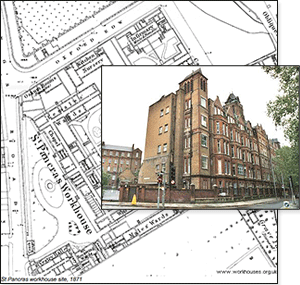
Pancras Work House, London
The English census lists his wife with another baby. Other records show her living in abject poverty, eeking out a living in the very worst of London's slums as a dressmaker before finally, at long last, succumbing to the Pancras Poor House.

Fred seems to have refused the humiliation and as a 12- and 13-year-old kid he ran free on London's streets—right up to the day when he was brought into the work house prepatory to their departure for Canada.

Who paid for their tickets?Aid societies abounded, trying to deal with the overwhelming poor in England's economic decline. But why would Catherine Ann even want to join a husband who'd left her destitute? She might well have loved him once, but now? 
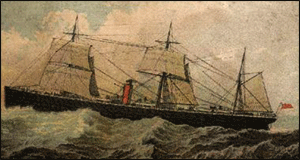
Sarmation Passenger Ship
Samartian
Yet what other choice did she have? Poor Eva was back and forth between the hospital and service, cleaning for a wealthy family; the other children were housed in a different section of the work house, away from the women's ward; thirteen-year-old Fred was on the streets. In May, she somehow got them all aboard the  Sarmartian and set sail from Liverpool for Canada on May 26, 1871. We'll never know her feelings.

In Kingston, Ontario, Canada, the children once again enjoyed a good education--though at fourteen years old it ended. Fred joined Kingston's Battery "A" as a bugler and enrolled in the gunnery school. When recruitment notices for a newly formed Mounted Police Force to police the Canada West went up, his life changed--and he became the Mountie who helped shape Canadian history.

Not that easy, though. He was only fifteen; you had to be eighteen. He hightailed it down to the recruitment office, and lied. Good plan, but he ran into the commandant of his school—Col. French. Worse, French went round to his house to report him to his father and, according to some reports, there was quite the row.
Last of the Mohecans
A self-confessed student of James Fenimore Cooper, Fred yearned to save the Indians out west from the dastardly American whiskey traders and envisioned himself "hobnobbing about with dusky Indian princesses."

In part, he was running away from home. Dick was a harsh man. To punish his boys, he took them out to the gym and boxed them into defeat, then beat them with a belt. Around the girls he managed to keep his fists to himself; nonetheless, they feared the lash of his tongue. So this must have been a hard fight. Finally Dick acquiesced. "Go ahead and take the lad! He'll get over his fascination for buffalo and redskins in short order, I reckon. If nothing else, it'll make a man out of him. But on one condition," he added. "He can only enlist for six months."

The Force pulled out of Kingston in June, 1874. Catherine Ann bid her oldest boy, not yet sixteen, adieu amidst all the fanfare, reminding him to say his prayers each night. She gave him a gold watch and chain and a diary that helped me find him a hundred years later.
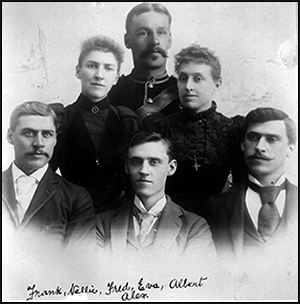
Bagley siblings in Toronto 1888
Poor Catherine didn't see him for another fourteen years. The occasion called for this remarkable photo with Fred with his siblings. He didn't stay long and was soon back on the Prairie.
_________

My quest isn't over. Looking for my missing grandmother Leona, I found Fred Bagley. I also found his parents and much mystery in Jamaica. But what about the children of Fred's other daughters? Leona's sisters? My cousins?

Finding Fred 3 of 5: Our Bigger Worlds, His and Mind

Frederick Augustus Bagley, colorized by Brenda Wilbee, his great-granddaughter
Fred Bagley
I DON'T RECALL recall the summer I made the trek back to Banff to see my friend Louis and to track down where the Bagleys and Goodfellows had lived and vacationed. All I knew was that Goodfellows owned a summer cabin. My mother ever the bone of contention between them had me wondering how "inconvenient"  it might have gotten for the Montegues and Capulets of Banff when they ran into each other at the grocery store.

I arrived about 5:00 to a town undergoing what looked like open heart surgery. Banff's Avenue had been fenced off. Huge diggy machines and bulldozers were hard at work along the center. I made a U-turn and headed for Bankhead, the old CPR ghost town Louis had made come alive in my mind and heart. Once a thriving community of immigrants brought in from all over Europe to mine the coal, this once-upon-a-time pristine town was home to about one hundred Germans, Ukranians, Italians, and others...and Chinese. A town of Once Upon A Time.


Main Street, Bankhead AB, circa 1910
ONCE UPON A TIME, Main Street ran along a steppe of Cascade Mountain, chuck full of coal and sole reason for Bankhead's existence. The mountain rose high to the left, where the town sat on another natural steppe before the mountain really took off, a trail going up and up to three portals reaching into the hiding coal. The mountain dropped off Main Street to the right, down to the slag heaps and mining operations. As Main Street headed north, the one-block commercial street narrowed and took a climb to Holy Trinity Church easily seen on the hill.

Trinity Church, Bankhead AB
Holy Trinity Church, Bankhead AB
While it was a Catholic church, Holy Trinity was typical of pioneering days, sharing the space and resources with other village denominations. Sunday mornings saw two or three services, while on Saturday nights the Polish, British, Irish, Russian, Germans, Hungarian, Slovakian, and Czech took turns hosting community dances. One week, it might be the Hungarians with a waltz. The next week, a German polka. Everyone participated except the Chinese, their way of life and religion far too surreal and mysterious to amalgamate.

Trip Adisor image of Bankhead AB church steps
All that's left today
Photo by Trip Advisor
I was prepared to find Bankhead overrun, each year more and more invasive, but I was astonished by the relentless reclamation. Early pictures of me digging around for laundry tubs and cigar cases in open spaces show a stark contrast to today’s crowding trees and underbrush. I had to scrabble up stony deer paths and push through young birch to find the steps to the old Catholic church I love so much. I did find it, and stood at the top, looking down; down into a basement where different nationalities took turns hosting Saturday night dances. Trees grew up from where women's skirts once swirled, ethnic music nothing more now than the wind.

campsight
Two Jack Lake
Evening coming on, I headed down the new road that cuts through Bankhead to Two Jack Lake and got myself a camping spot. While roasting a hotdog, I wondered why the draw to Bankhead, perhaps the same draw for Banff--my great-grandfather. When Fred was stationed in Banff—first in 1888 with the first detachment and then again in 1890 when he married Lucy May—he'd started the Bankhead Band. It was in this old ghost town where a kid named Louis Trono met him as a nine-year-old in knickers.
Your granddad came out from Banff to start a band. I wanted to play trumpet, but no matter how many times I asked he kept saying I was just a kid. Finally, to shut me up, I think, he gave me his own trumpet and told me to take it home for a week, see what I could do. When I finished playing for him the following week, he said to the band members, :Now here is how you play music." But he had enough trumpet players. He gave me a trombone. I've been playing trombone ever since, all over the world.
I settled down with a crackling fire under the black pine, content to be “home,” listening to the music of my great-grandfather reaching through time and playing in the trees--and looking forward to knocking on Louis' door the next day to say hi. Perhaps a dinner at Banff Springs Hotel would be fun, where Louis still played his trombone in what was left of my great-grandfather's "Banff Hot Spring Hotel Band."

I was saddened to learn the next day from the curators at the Whyte Rocky Mountain Museum that Louis had died three years before, his wife just three weeks ago. Had it been that long since I'd been to Banff? I had to blink a few times.

The good news, the curators were quick to share, was that Banff had renamed the bandstand for Louis and installed a lovely plaque with a bit of Louis’ fascinating musical history. I was not surprised to find Fred mentioned as his mentor and teacher. How rich my life has been by looking for my missing grandmother. First Fred, then Uncle Dale. Louis. Banff feels a little lonely for me now, without my friend.

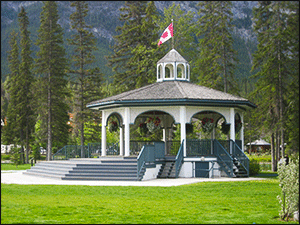
Banff Rotunda
Getting any information on where Fred and Lucy May might have lived, though, was a bit elusive. In the public library, I found a huge book called I Live In A Postcard, a collection of histories on Banff's families. Fred and Lucy May weren't listed. Next door at the museum archives they were equally surprised, but pictures of his funeral show a long line of friends stretching all down Banff Avenue, many of them stepping into the cortege as the hearse rounded the corner onto Buffalo and out to the cemetery. His hearse was accompanied by six Mountie, three to the left, three to the right, Mounties stationed all along the way, each raising an arm in salute as my grandfather passed for the last time.

A curator found some color slides. Goodness. The day was ablaze with autumn orange leaves and riotous red tunics! I hadn't yet been born but I could smell the day deep inside.

Bagley GravestoneI went straight to the cemetery and had a picnic supper at his grave, where he’d been interned with a Union Jack draped over his coffin. I’d stopped on the way up to see one of Mum's many Goodfellow cousins in Salmon Arm, BC. Sylvia was exactly half way between home and Banff, a convenient stopover. After some lunch she'd sent me on my way with an egg salad sandwich and other hand baked goodies. Now, perched on the Bagley plot's concrete edging, with the chilly granite of the tombstone at my back, I munched it all down, looking up at Sulphur Mt. as it plunged skyward in a blanket of trees. I got to thinking about the entrapment of time—a terrible inconvenience for writers and historians. How is that I was sitting here, alive, with Fred dead and my grandchildren having their whole lives ahead of them? Weird.

My second day it was back in the archives, where Lena, one of the curators, pulled out the old tax records, heavy tombs of boring information like lot and block and assessed value. I learned that Fred never owned his house—there are no records of him ever paying taxes. The Goodfellows, however, had a cabin and property worth $650. Taxes ran from $6 to about $11 or $12.

a Banff cabin
Craig Cabin
perhaps similar to the Goodfellows
The old phone books were the mother lode. Major and Mrs. Fred Bagley lived on the corner of Elk and Beaver; which is now an apartment building. Rats. I couldn't go knock on the door and charm my way in. It turns out Walter and Isabella Goodfellow lived only 3 or 4 blocks away at 422 Marten Street, also an apartment building.

Rats, rats, and more rats. I had my heart set on being snoopy. I did find the answer, though, as to how awkward it might have been for the families--one trying to see their granddaughter, the other determined they not. Answer: Very awkward.

Hotsprings
Banff Hot Springs
I ended my third day at Banff—a glorious sunny day with gentle breezes—researching in the public library across from a man I’d spotted the night before at the hot springs.

A friend and I used tell each other stories of complete strangers we’d see. So there I was the night before, reveling in the hot springs that's made Banff so famous, making up stories about the various people I saw. I had this guy pegged for a banker, widower, living in his head and trying to pull himself out of it. At the library we started to chat. Turns out he's researching residential schools in Canada for an online class he was taking. Shows how remarkably creative I can be.

In the morning I was to head down to Pincher Creek to meet my mother’s “missing” cousin, Doug Connelly. By the way, Pincher Creek is where the Mounties raised their horses and where Old Buck, Grandfather's horse, was put to pasture after many years of service. The town that grew up around the Mountie horse ranch is nestled in the Rocky Mountain foothills, and I am quite fond of the rolling, dry countryside, caught as it is between the mountains and plains. I look forward to meeting more Bagley kin, and to learn what memories Doug may have of his grandfather.

For a treat, I stayed my last night at the Banff Hostel, a grand place for little money and all the amenities. Best yet, the old Train Depot hauled out of Bankhead in 1922 sits right next door.

I can't believe it. I'm right back to Once Upon A Time!

Bankhead Train Depot, now in Banff AB. Brenda Wilbee on porch
Yup, that's me!


Finding Fred 4 of 5: Answer To A Question

Frederick Augustus Bagley, colorized by Brenda Wilbee, his great-granddaughter
Fred Bagley
I STARTED MY JOURNEY looking for my grandmother Leona Bagley, but Fred's cookie-crumb trail had taken on a life's of its own. I heard about my mother's cousin Doug Connelly, son of Leona's younger sister Marian. A rancher, he lived at Pincher Creek with his wife Sally. And yes, it turns out that Doug and Sally were the couple to donate Fred's badges that my son Phil found in the Pincher Creek Museum several years before. "Cousins perhaps?" was now a solid "cousins once removed." Or is it "second cousins?"

Remember, family lore held that when Leona wanted to leave my Grandpa Les and return home, Fred Bagley had told her yes, but leave the brat behind. It had irked me, but but what I was learning about Fred was that he loved music, horses, and kids. Did he love my mother?


Pincher Creek, photo by Brenda Wilbee
Pincher Creek
PINCHER CREEK LIES in the Porcupine foothills of the Rocky Mountains in Southern Alberta. Here the Mounties of Canada West bred their horses and here is where Old Buck, Fred's pony, was put to pasture in his old age. A singular reward; all the others were unceremoniously sent off to a glue factory. No one had it in their hearts to condemn a famous and faithful pony to such a fate. Old Buck, however, was allowed to roam the prairie at at will.

Old Buck, Frederick Augustus Bagley's Mountie pony
Old Buck
my great-grandfather's pony
He quickly formed a routine, circling between Fort Macleod, Fort Calgary, and Pincher Creek, where he was always welcomed with carrots and apples. But in 1898, at 32 years of age and ancient in horse years, he was "humanely put down." This is the year before master, my great-grandfather, after 25 years of service with the Mounties, resigned. Fred and Old Buck were in it together, beginning to end.

Here too in Pincher Creek is the old homestead and home of my mother's lost-and-found cousin, Doug Connelly, keeper of the Bagley artifacts, manuscripts, and family Bible. Doug's grandfather homesteaded this land and his mother, Fred's youngest daughter, married into this cozy place on the prairie.

Doug and Sally Connelly Gate
Doug and Sally Connelly
Pincher Creek AB
I hardly knew what to expect when I drove up to the gate--though my mother insisted and assured me that Doug and Sally would be happy to meet me. Turns out Mum was right, so right in fact that Doug and Sally let me spend the entire day at their kitchen table pouring through letters and military orders and diaries, and showing me the many artifacts still in their possession. Much of the material has been loaned out to Glenbow in Calgary and the little museum in Pincher Creek, but Doug has retained several of our grandfather's things: a swagger stick; a cane of sorts; a souvenir horse-bit given to him when he escorted Queen Victoria's carriage in her Diamond Jubilee parade through London's streets in 1887; a silver tea set he won in rifle match I believe it was; as well as many other interesting and fascinating things.

The most fascinating, however, was my mother's name recorded in Fred's handwriting in his Bible. There she was, Shirley Elizabeth Goodfellow--Oct. 2, 1928. My mother's name, Fred's pen. I think I loved my great-grandfather at that moment and found it hard not to cry, to see that he did in fact acknowledge my mother. Her brother's story of Fred wheeling a whicker pram onto the train in Banff and off again in Vancouver, a gift to her, came to mind. I no longer had to wonder. Fred Bagley loved my mother.

This much came even more clear as I read his many letters to his youngest daughter Marian. His affection, his humor, his delight in all three of his girls--Kate, Pittising (Leona), and Tiny (Marian)--comes singing off the antiquated pages. And his joy and concern for his grandchildren are equally evident. Did he, each October 2nd, wonder where his eldest grandchild was? Did he wonder how she was doing? Did he look at her name in his Bible and ponder the mysterious circumstances that brought about their separation? Did her absence bring him sorrow?

He was a man who kept track of his brother and sisters scattered about the States and Canada; he kept track of his daughters; he loaded his Christmas tree each year in Banff with gifts for Dale, Doug, and Mick. Did he miss not having presents for Mum?

Leona and Les Goodfellow
Leona and Les
The other discovery that made me happy were three photographs of my grandparents: Les and Leona. All three reveal an affection and energy. Despite what happened, Les and Leona were a couple in love--and in love over a long period of time.

"The three girls," Doug told me, speaking of his mother, my grandmother, and our aunt Kate, "were very close. They kept Leona's secret all those years--at least until Kate spilled the beans on her deathbed." Doug speaks and I stare at these images of my grandparents, so in love, so happy, sharing their lives in a way I've never experienced--and I wonder, what happened to them? How did this all fall apart?

I know Les had invited his best friend to live with him and Leona. I know my grandfather was an alcoholic. He liked to party and was probably very much the Roaring Twenties playboy. I'm not sure how all this sat with Leona. But at some point Les moved out of the little home she'd bought with her own money to go live with Marguerite. He left Philip behind. What was that all about? We know Leona was alone when Mum was born.

So what happened in that little house in Vancouver? And why did it mean I lost my grandmother? And Fred?

After saying good-bye around five o'clock, I drove west to Fort Macleod and the open prairie. I camped along the Bow River, a place I'd taken my sons one year. Sleeping in the back of my jeep, listening to the river play over the rocks, and then the rain, I thought of families and how when we do the best we can and still do lose.

Some people easily sum up the story with a shrug and "it's all for the best." I don't think so. We just don't have the luxury to line up "what was" and "what could have been" and declare a winner.

All I know is this. Fred lived a life of adventure, intrigue, and faithful duty, surrounding himself with love, music, and family. From his perspective, it wasn't my grandmother and himself who'd gone missing. From his corner, it was my mother who was lost.