October 21, 2018

Finding Fred 3 of 5: Our Bigger Worlds, His and Mind

Frederick Augustus Bagley, colorized by Brenda Wilbee, his great-granddaughter
Fred Bagley
I DON'T RECALL recall the summer I made the trek back to Banff to see my friend Louis and to track down where the Bagleys and Goodfellows had lived and vacationed. All I knew was that Goodfellows owned a summer cabin. My mother ever the bone of contention between them had me wondering how "inconvenient"  it might have gotten for the Montegues and Capulets of Banff when they ran into each other at the grocery store.

I arrived about 5:00 to a town undergoing what looked like open heart surgery. Banff's Avenue had been fenced off. Huge diggy machines and bulldozers were hard at work along the center. I made a U-turn and headed for Bankhead, the old CPR ghost town Louis had made come alive in my mind and heart. Once a thriving community of immigrants brought in from all over Europe to mine the coal, this once-upon-a-time pristine town was home to about one hundred Germans, Ukranians, Italians, and others...and Chinese. A town of Once Upon A Time.


Main Street, Bankhead AB, circa 1910
ONCE UPON A TIME, Main Street ran along a steppe of Cascade Mountain, chuck full of coal and sole reason for Bankhead's existence. The mountain rose high to the left, where the town sat on another natural steppe before the mountain really took off, a trail going up and up to three portals reaching into the hiding coal. The mountain dropped off Main Street to the right, down to the slag heaps and mining operations. As Main Street headed north, the one-block commercial street narrowed and took a climb to Holy Trinity Church easily seen on the hill.

Trinity Church, Bankhead AB
Holy Trinity Church, Bankhead AB
While it was a Catholic church, Holy Trinity was typical of pioneering days, sharing the space and resources with other village denominations. Sunday mornings saw two or three services, while on Saturday nights the Polish, British, Irish, Russian, Germans, Hungarian, Slovakian, and Czech took turns hosting community dances. One week, it might be the Hungarians with a waltz. The next week, a German polka. Everyone participated except the Chinese, their way of life and religion far too surreal and mysterious to amalgamate.

Trip Adisor image of Bankhead AB church steps
All that's left today
Photo by Trip Advisor
I was prepared to find Bankhead overrun, each year more and more invasive, but I was astonished by the relentless reclamation. Early pictures of me digging around for laundry tubs and cigar cases in open spaces show a stark contrast to today’s crowding trees and underbrush. I had to scrabble up stony deer paths and push through young birch to find the steps to the old Catholic church I love so much. I did find it, and stood at the top, looking down; down into a basement where different nationalities took turns hosting Saturday night dances. Trees grew up from where women's skirts once swirled, ethnic music nothing more now than the wind.

campsight
Two Jack Lake
Evening coming on, I headed down the new road that cuts through Bankhead to Two Jack Lake and got myself a camping spot. While roasting a hotdog, I wondered why the draw to Bankhead, perhaps the same draw for Banff--my great-grandfather. When Fred was stationed in Banff—first in 1888 with the first detachment and then again in 1890 when he married Lucy May—he'd started the Bankhead Band. It was in this old ghost town where a kid named Louis Trono met him as a nine-year-old in knickers.
Your granddad came out from Banff to start a band. I wanted to play trumpet, but no matter how many times I asked he kept saying I was just a kid. Finally, to shut me up, I think, he gave me his own trumpet and told me to take it home for a week, see what I could do. When I finished playing for him the following week, he said to the band members, :Now here is how you play music." But he had enough trumpet players. He gave me a trombone. I've been playing trombone ever since, all over the world.
I settled down with a crackling fire under the black pine, content to be “home,” listening to the music of my great-grandfather reaching through time and playing in the trees--and looking forward to knocking on Louis' door the next day to say hi. Perhaps a dinner at Banff Springs Hotel would be fun, where Louis still played his trombone in what was left of my great-grandfather's "Banff Hot Spring Hotel Band."

I was saddened to learn the next day from the curators at the Whyte Rocky Mountain Museum that Louis had died three years before, his wife just three weeks ago. Had it been that long since I'd been to Banff? I had to blink a few times.

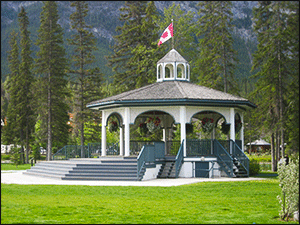
The good news, the curators were quick to share, was that Banff had renamed the bandstand for Louis and installed a lovely plaque with a bit of Louis’ fascinating musical history. I was not surprised to find Fred mentioned as his mentor and teacher. How rich my life has been by looking for my missing grandmother. First Fred, then Uncle Dale. Louis. Banff feels a little lonely for me now, without my friend.

Banff Rotunda
Getting any information on where Fred and Lucy May might have lived, though, was a bit elusive. In the public library, I found a huge book called I Live In A Postcard, a collection of histories on Banff's families. Fred and Lucy May weren't listed. Next door at the museum archives they were equally surprised, but pictures of his funeral show a long line of friends stretching all down Banff Avenue, many of them stepping into the cortege as the hearse rounded the corner onto Buffalo and out to the cemetery. His hearse was accompanied by six Mountie, three to the left, three to the right, Mounties stationed all along the way, each raising an arm in salute as my grandfather passed for the last time.

A curator found some color slides. Goodness. The day was ablaze with autumn orange leaves and riotous red tunics! I hadn't yet been born but I could smell the day deep inside.

Bagley GravestoneI went straight to the cemetery and had a picnic supper at his grave, where he’d been interned with a Union Jack draped over his coffin. I’d stopped on the way up to see one of Mum's many Goodfellow cousins in Salmon Arm, BC. Sylvia was exactly half way between home and Banff, a convenient stopover. After some lunch she'd sent me on my way with an egg salad sandwich and other hand baked goodies. Now, perched on the Bagley plot's concrete edging, with the chilly granite of the tombstone at my back, I munched it all down, looking up at Sulphur Mt. as it plunged skyward in a blanket of trees. I got to thinking about the entrapment of time—a terrible inconvenience for writers and historians. How is that I was sitting here, alive, with Fred dead and my grandchildren having their whole lives ahead of them? Weird.

My second day it was back in the archives, where Lena, one of the curators, pulled out the old tax records, heavy tombs of boring information like lot and block and assessed value. I learned that Fred never owned his house—there are no records of him ever paying taxes. The Goodfellows, however, had a cabin and property worth $650. Taxes ran from $6 to about $11 or $12.

a Banff cabin
Craig Cabin
perhaps similar to the Goodfellows
The old phone books were the mother lode. Major and Mrs. Fred Bagley lived on the corner of Elk and Beaver; which is now an apartment building. Rats. I couldn't go knock on the door and charm my way in. It turns out Walter and Isabella Goodfellow lived only 3 or 4 blocks away at 422 Marten Street, also an apartment building.

Rats, rats, and more rats. I had my heart set on being snoopy. I did find the answer, though, as to how awkward it might have been for the families--one trying to see their granddaughter, the other determined they not. Answer: Very awkward.

Hotsprings
Banff Hot Springs
I ended my third day at Banff—a glorious sunny day with gentle breezes—researching in the public library across from a man I’d spotted the night before at the hot springs.

A friend and I used tell each other stories of complete strangers we’d see. So there I was the night before, reveling in the hot springs that's made Banff so famous, making up stories about the various people I saw. I had this guy pegged for a banker, widower, living in his head and trying to pull himself out of it. At the library we started to chat. Turns out he's researching residential schools in Canada for an online class he was taking. Shows how remarkably creative I can be.

In the morning I was to head down to Pincher Creek to meet my mother’s “missing” cousin, Doug Connelly. By the way, Pincher Creek is where the Mounties raised their horses and where Old Buck, Grandfather's horse, was put to pasture after many years of service. The town that grew up around the Mountie horse ranch is nestled in the Rocky Mountain foothills, and I am quite fond of the rolling, dry countryside, caught as it is between the mountains and plains. I look forward to meeting more Bagley kin, and to learn what memories Doug may have of his grandfather.

For a treat, I stayed my last night at the Banff Hostel, a grand place for little money and all the amenities. Best yet, the old Train Depot hauled out of Bankhead in 1922 sits right next door.

I can't believe it. I'm right back to Once Upon A Time!

Bankhead Train Depot, now in Banff AB. Brenda Wilbee on porch
Yup, that's me!


Finding Fred 4 of 5: Answer To A Question

Frederick Augustus Bagley, colorized by Brenda Wilbee, his great-granddaughter
Fred Bagley
I STARTED MY JOURNEY looking for my grandmother Leona Bagley, but Fred's cookie-crumb trail had taken on a life's of its own. I heard about my mother's cousin Doug Connelly, son of Leona's younger sister Marian. A rancher, he lived at Pincher Creek with his wife Sally. And yes, it turns out that Doug and Sally were the couple to donate Fred's badges that my son Phil found in the Pincher Creek Museum several years before. "Cousins perhaps?" was now a solid "cousins once removed." Or is it "second cousins?"

Remember, family lore held that when Leona wanted to leave my Grandpa Les and return home, Fred Bagley had told her yes, but leave the brat behind. It had irked me, but but what I was learning about Fred was that he loved music, horses, and kids. Did he love my mother?


Pincher Creek, photo by Brenda Wilbee
Pincher Creek
PINCHER CREEK LIES in the Porcupine foothills of the Rocky Mountains in Southern Alberta. Here the Mounties of Canada West bred their horses and here is where Old Buck, Fred's pony, was put to pasture in his old age. A singular reward; all the others were unceremoniously sent off to a glue factory. No one had it in their hearts to condemn a famous and faithful pony to such a fate. Old Buck, however, was allowed to roam the prairie at at will.

Old Buck, Frederick Augustus Bagley's Mountie pony
Old Buck
my great-grandfather's pony
He quickly formed a routine, circling between Fort Macleod, Fort Calgary, and Pincher Creek, where he was always welcomed with carrots and apples. But in 1898, at 32 years of age and ancient in horse years, he was "humanely put down." This is the year before master, my great-grandfather, after 25 years of service with the Mounties, resigned. Fred and Old Buck were in it together, beginning to end.

Here too in Pincher Creek is the old homestead and home of my mother's lost-and-found cousin, Doug Connelly, keeper of the Bagley artifacts, manuscripts, and family Bible. Doug's grandfather homesteaded this land and his mother, Fred's youngest daughter, married into this cozy place on the prairie.

Doug and Sally Connelly Gate
Doug and Sally Connelly
Pincher Creek AB
I hardly knew what to expect when I drove up to the gate--though my mother insisted and assured me that Doug and Sally would be happy to meet me. Turns out Mum was right, so right in fact that Doug and Sally let me spend the entire day at their kitchen table pouring through letters and military orders and diaries, and showing me the many artifacts still in their possession. Much of the material has been loaned out to Glenbow in Calgary and the little museum in Pincher Creek, but Doug has retained several of our grandfather's things: a swagger stick; a cane of sorts; a souvenir horse-bit given to him when he escorted Queen Victoria's carriage in her Diamond Jubilee parade through London's streets in 1887; a silver tea set he won in rifle match I believe it was; as well as many other interesting and fascinating things.

The most fascinating, however, was my mother's name recorded in Fred's handwriting in his Bible. There she was, Shirley Elizabeth Goodfellow--Oct. 2, 1928. My mother's name, Fred's pen. I think I loved my great-grandfather at that moment and found it hard not to cry, to see that he did in fact acknowledge my mother. Her brother's story of Fred wheeling a whicker pram onto the train in Banff and off again in Vancouver, a gift to her, came to mind. I no longer had to wonder. Fred Bagley loved my mother.

This much came even more clear as I read his many letters to his youngest daughter Marian. His affection, his humor, his delight in all three of his girls--Kate, Pittising (Leona), and Tiny (Marian)--comes singing off the antiquated pages. And his joy and concern for his grandchildren are equally evident. Did he, each October 2nd, wonder where his eldest grandchild was? Did he wonder how she was doing? Did he look at her name in his Bible and ponder the mysterious circumstances that brought about their separation? Did her absence bring him sorrow?

He was a man who kept track of his brother and sisters scattered about the States and Canada; he kept track of his daughters; he loaded his Christmas tree each year in Banff with gifts for Dale, Doug, and Mick. Did he miss not having presents for Mum?

Leona and Les Goodfellow
Leona and Les
The other discovery that made me happy were three photographs of my grandparents: Les and Leona. All three reveal an affection and energy. Despite what happened, Les and Leona were a couple in love--and in love over a long period of time.

"The three girls," Doug told me, speaking of his mother, my grandmother, and our aunt Kate, "were very close. They kept Leona's secret all those years--at least until Kate spilled the beans on her deathbed." Doug speaks and I stare at these images of my grandparents, so in love, so happy, sharing their lives in a way I've never experienced--and I wonder, what happened to them? How did this all fall apart?

I know Les had invited his best friend to live with him and Leona. I know my grandfather was an alcoholic. He liked to party and was probably very much the Roaring Twenties playboy. I'm not sure how all this sat with Leona. But at some point Les moved out of the little home she'd bought with her own money to go live with Marguerite. He left Philip behind. What was that all about? We know Leona was alone when Mum was born.

So what happened in that little house in Vancouver? And why did it mean I lost my grandmother? And Fred?

After saying good-bye around five o'clock, I drove west to Fort Macleod and the open prairie. I camped along the Bow River, a place I'd taken my sons one year. Sleeping in the back of my jeep, listening to the river play over the rocks, and then the rain, I thought of families and how when we do the best we can and still do lose.

Some people easily sum up the story with a shrug and "it's all for the best." I don't think so. We just don't have the luxury to line up "what was" and "what could have been" and declare a winner.

All I know is this. Fred lived a life of adventure, intrigue, and faithful duty, surrounding himself with love, music, and family. From his perspective, it wasn't my grandmother and himself who'd gone missing. From his corner, it was my mother who was lost.


September 19, 2018

Antidote to Systemic Racism

Ann Arbor, MI -- 1964
Tresa, Tim, Me, Dad, Linda, Mum
The Sept. 6 shooting of an unarmed back man--in his own home, minding his own business--dispels any notion that our police force is innocent of systemic racism. What is the answer?

I came to the U.S. at the height of civil rights in the mid-sixties and discovered an abhorrence for racial inequality--seeded by my Civics teacher who had us read books like Animal Farm, Black Like Me, To Kill A Mockingbird. With each book, we had to write an essay--which Mr. Stewart rebutted until satisfied--and I began to seriously write. My early teen angst was profound and needed an outlet.

I'd come from a county where policemen did not apply fire hoses to anyone, a country to where escaped slaves had fled, and I found my thirteen-year-old self alarmed that so many white people had so many excuses for police racism and brutality. I came out of that civics class with an A and a heart for the social justice.

Flash forward forty years. After the 2008 presidential elections, St. Louis Police Officer Ronald L. Fowlkes emailed 23 other city cops with "I can’t believe I live in a country full of NIGGER LOVERS!” followed by 31 exclamation points. This is what that looks like: !!!!!!!!!!!!!!!!!!!!!!!!!!!!!!!

We didn't need to read To Kill A Mocking Bird to know that African Americans live in a scary shadow no white person ever has to know. Today, in 2018, the shadow is more scary and obvious than ever. The Black Lives Matter movement emerged--but was effectively deflected with All Lives Matter and police acquittals despite evidence. No more water hoses to be sure, but lots of shooting down of unarmed black kids and men with immunity. The shooting of Botham Jean is just one more.

I was thirteen when Sandy, a black girl, and I became friends. I was thirteen when I had sleepovers at her house, with too many children crammed into close quarters, Sandy and I curled up on broken bed, my back to the thin wall that allowed me to hear the black dialect of Michigan's impoverished working class. I was thirteen when I understood that her family faced discrimination daily, that emotional violence and the threat of physical harm met her every day at school. I was thirteen when I understood that I loved my friend and I loved her family.

Love freed me from the sin of racism so prevalent in this country I adopted as my own.

Here's the thing: You can't love what you don't know. I knew and loved when I was thirteen. Hanging out with Sandy eased my angst. I invite us all to do the same. 

September 17, 2018

Why God Gives Us Dogs

Pensi just was. I was three when Dad carried her into the Haney house looking more dead than alive, a shaggy black and white sheep dog just out of the vet’s office.

“You have her bed ready, Betty?” he called to Mum, kicking the door shut with a boot.

“In the girls’ room!”

Linda, Tresa, and I, three little girls, two, three, and four years old, me in the middle, traipsed along behind him, trying not to get in the way as he entered our perfectly square room and eased Pensi down onto a collection of clean towels Mum had fluffed up in the corner.

“Daddy,” I said, “I think she’s dead.”

“She’s just sick. She’ll feel better soon.”

Mum arrived with another towel, this one warmed in the oven.

“She looks dead, Mummy,” I said again, alarmed at how Mum took the time to lift each paw to tuck in.

“It’ll take a couple of days. Remember, she had an operation—”

I couldn't picture how they "spayed" dog. So I imagined a man in a white coat setting the sharp tip of a shovel against Pensi’s belly, heel to the blade, and giving a sudden lunge. That’d stop a dog from having puppies all right. “Are you sure she’s not going to die?” I asked.

“She’ll be fine.” Dad was squatting, carefully gauging her condition. When he gave her a comforting pat, Pensi opened her eyes, too weak to do much more than stare at us through pain-laced eyes, but apparently grateful for the lovely warmth and soft scratching behind her ears.

In the morning I found Pensi gone. “She died!” I shrieked. “She died!”

Mum popped her head into the room. “She’s in the kitchen. Eating her breakfast.”

I jumped up and down in joy to see her lapping up a thin gruel. By the day’s end she was tearing all over the place, trying Mum’s patience, licking our noses, and whining to go out.

At the time, my father was building our new house in the next town over, deep in the forest and assessable only by an abandoned logging road. When he loaded up our ’52 Chev with his tools, Pensi was right there, good company for him while he hammered and sawed--when she wasn't stalking the surrounding woods for skunks and smelling out the raccoons, or sniffing the trail of an old bear. The days we went along, Pensi played with us on the cement chutes and in the gravel, barking happy barks.
I was four when we moved into our new house, incomplete. It had outside walls, partial flooring, and a roof. Each night Dad tucked us into three army cots. He zipped us into snug “mummy” bags, and we said our prayers while starlight fell through the gaping holes that would one day be windows. There were no interior walls to speak of, and before I closed my eyes I could hear and catch flickering glimpses of my parents talking quietly before a fire on the other end of the house—Pensi curled at their feet, one ear up, listening for danger we might need to fear. I was four years old, the nights alive with starlight and fresh forest smells, and never in my life have I felt so safe. Pensi on watch.

Our Auntie Vi was our mother’s aunt. She often visited from Victoria, a ferry ride away. She wasn’t a dog lover. Whenever Pensi licked our noses—or we licked hers, she’d squeal in mock horror; and I, at least, lived to make her squeal, for Auntie did such a fine job. “Ick! How can you?” she’d cry, throwing up her hands, rolling her eyes, the three of us girls giggling and laughing and rolling around on the sofa, begging Pensi to “do it again!”

“Don’t you know where that dog’s nose has been?”

We knew. Did we care?

“What about her breath?” insisted Auntie.

What about it?

Winter coming on, windows in, Dad installed the furnace. A huge thing, four by four and floor to ceiling, taking up a corner of the utility room. I was scared of it. At night I could hear it kick in, the flames ignite with a swoosh. What if it burst into fire and we all burned to death? But then I remembered Pensi. She’d bark and wake us up.

We had no running water. Mum sometimes called on one of us to take a pot out to the rain barrel. When it snowed? A whole new job! My grandfather used to say that dogs and children know what snow is for. We did. Out we tumbled in our snowsuits, with pots, pans, and Pensi. We discovered that if we packed a snowball and raised our arms, she’d set out pell-mell, snow flying, yelping for joy as we launched the missiles—only to stop dead in her tracks dismayed. Where’d they go? A small poof, and they were gone, a dimple in the snow.

That Christmas, Christmas Eve morning, Grandma and Grandpa and our Uncle Stan arrived from Vancouver to help Dad get his new water line hooked up to the newly installed city main. They suited up and grabbed their shovels. Grandma, Pensi, and us girls went out to get our last snow for morning tea. Grandma taught us how to make snow angels; Pensi taught us how to wreck them; and in the afternoon we all played on the iced-over swamp, prickled through with bulrushes and skunk cabbages. The men hauled the three of us around on brooms, swooshing us through the rushes and reeds and around in circles while Pensi slithered and slid from one to the another and on to the third, barking and dancing, her body twisting in glee so contagious we kept spilling off in fits of laughter. I tried to pull her on with me but we both went flying. I abandoned her; I needed my hands to hang onto the broomstick. She retaliated by yapping at my coattails and pretending to growl. That hallowed night the grownups got ready for Christmas Eve, getting out the ginger ale and finding safety pins so we could hang our socks, and Mum poured us a bath—our first since moving in. Pensi, remembering such things, slunk away and hid.

The house slowly went up around us. Next door, trees started to come down in preparation for a subdivision; and the old bear, hungry or curious or both, began making appearances. This made Dad and some of the other men nervous. More and more kids were walking the logging trail to school, civilization slowly making inroads into the forest. Dogs, I suppose, were insufficient protection and one day Dad and Pensi, along with some men with guns, went out to stop trouble before it could happen.

I was nervous—not for Dad. Dad could take care of himself. But one swipe and that bear could send Pensi flying, smack her up against a tree, and that’d be the end of her. No need to worry. The bear was shot and Dad, who’d done some taxidermy as a teenager, skinned it and began tanning the skin to make a rug. Each day after school, I came skipping around the back corner of the house and hopped onto the patio. I’d lift the heavy ceramic lid of the tanning vat sitting right by the back door and peer in with plugged nose, reset the lid, and bounce on into the house. “Is it ready?” I’d badger, finding Dad.

“Not yet.”

When it was finally done, he gave it to the LaRues in Haney. “But that’s our bear rug!” I was inconsolable. He tried to explain that he hadn’t done a good job, and that Mrs. LaRue wanted it, holes and all. But I wanted it! And hadn’t I kept an eye on it? Checked it every day? To satisfy me, Mum took me over to the LaRue’s, and Mrs. LaRue let me wallow in the cool lush fur. I’m not sure seeing the holes helped because for a long time I grieved the loss of that rug. Only Pensi’s cool, lush fur could comfort me.

Once she and Dad went for a walk and next thing we knew we could hear him hollering out by the swamp. Pensi had startled a skunk. Must have stuck her nose right up against its rump and gotten it full in the face, for she was banging her head against the ground, pawing her ears, whining and crying, groveling all over the ground and rubbing herself in the mud. Linda, Tresa, and I watched through the big plate glass window in the family room while Mum carried out some clean duds for dad and a shovel—going as far as she dared. “Here! I’ll get a tub going for you and Pensi!” she hollered.

To our amazement, she seemed to know exactly what to do. She set the hose into the tub outdoors, came in, started the electric kettle, dug around for what tins of tomato juice she could find—and took it all outside, along with the big bar of Fels Naptha soap.

I thought for sure Dad would have to drag Pensi bawling to the tub, but she came willingly enough. Her misery was palpable. Baths over, Dad went back to the swamp to bury his clothes.

“Why can’t we just wash them?” Tresa asked Mum, our noses pressed against the glass.

“They’d stink up the house for weeks.”

“Why not hang them on the line?” I asked.

“That kind of smell you have to bury.”

She didn’t let Pensi inside for days. The tomato juice supposedly cut the smell, but it was in her fur so badly it took a week of rolling around in the dirt before she got it all out.

She did hate to get her bangs cut. It took all three of us to hold her down while Mum went at the shag with determination; me scared the whole time she’d poke Pensi’s eyes out, Tresa crying over Pensi’s distress. On the other end of the scale, she loved chasing cars, which brought equal anxiety. At first it wasn’t much of a problem. Cars were few and far between on the old logging road. It was more of a problem when we went to the river park or into Vancouver to visit Grandma and Grandpa. On such occasions Dad’s uncharacteristically harsh commands went unheeded, and Mum, afterward whopping Pensi’s bum with a rolled up newspaper, only managed to send her skulking off. Next car that came along? Off she shot.

Sometimes I grew dizzy watching her race alongside the back wheel of a car. A sheep dog, she had lightning speed, and she nosed right in while I held my breath and teetered on my feet and Mum and Dad hollered. Eventually the car outdistanced her and she’d trot back, shying away from Mum and looking guiltily at Dad.

We’d probably been living in our forest house a couple of years, interior walls up and doors at least installed in the bathrooms, when Dad began spending his Saturdays working with a few of the men erecting Southside Baptist Church. He always took Pensi. One night he came home early without her. She’d been hit by a car while he and Jack Bariff stuccoed the exterior walls.

That night, after Dad tucked us in, helping us with our prayers and giving us each a kiss, Linda whispered in the dark, “He put her in the living room. She’s under a tarp. He’s going to bury her early in the morning." She always knew such things.

Our living room was Dad’s workshop—full of sawdust and saw horses, saws and tables. It’s where he hauled in the trees he'd felled and debarked them, and where he measured and cut the kitchen cabinet doors. I got out of bed and tiptoed down the long, cold hallway and cracked the fancy door Dad had made, leading into the living room. Moonlight fell through the bank of windows, casting an eerie glow and there, at the far end, a heap. Dead Pensi. An hour later I woke up crying.

Dad climbed into my bed. I came up for air, blubbering and tasting the salt of my tears. “Daddy? Can you make a rug out of her? Like you did the bear?”

I often wonder what went through his head. I’m surprised he didn’t laugh. That he understood my loss, though, is clear. “You’ll always have Pensi. Close your eyes, think of a special day you shared. Can you see her?”

I could. We were at Grandpa’s beach house, running through the waves with a crowd of seagulls cawing above us, looking like noisy hankies headed for heaven on a wind.

“Whenever you’re sad or lonely, or whenever you’re happy and just want to play, go there, go inside your head where Pensi will always live.”

“But she can’t make me happy, in my head.”

“You’d be surprised. It’s why God gives us dogs.”

Years have passed, decades in fact, and Dad was right. A thousand times I’ve gone there, a thousand times more, inside my head where Pensi lives, racing along the water’s edge, waves lapping, the ever-present gulls raising a ruckus. Sad or lonely, happy or scared, or simply skiing down a mountain slope in the pristine beauty and clear skies of our world, I find Pensi unbidden kicking up her heels, snow flying.

She barks, and licks my nose.

Six Orange Crates and "Stuff"

Wayne and me Spring 1970
Eighteen years old and headed for college--years ago. At the time I was living in Mesa, AZ, and on "move in" day at Grand Canyon College (now a university) my best friend Wayne rolled into the driveway with a borrowed VW van. I had everything ready: six orange crates packed with everything I owned.

Since then I've moved a gazillion times, each time with an ever increasing accumulation of life's flotsam. The last time, I got rid of an antique piano, six bookshelves of books and the books, bins of research, sacks of clothes I no longer fit, pictures, paintings, pots, pans, canning jars, salves, and ointments that my youngest swore were around before he was born.

The last time I moved, I tossed at least 300 books this time around. Hundreds of research files, box after box of ever more research, garden boots, clarinet music from junior high ("You're never going to  play music so many black notes," said the youngest child ), even paper dolls I've been hauling around since I was ten years old and living in Northern California.

Each time I go through this process, I inevitably thought of Wayne and that beastly hot day in Phoenix when he helped transport my six orange crates of belongings into a small dorm room and the rest of my life. Where did all this stuff come from? What happened to the days when I needed so little to create a corner of home for myself?

For six summers while driving tour buses in Alaska I lived in small spaces. I loved it. But I also knew I missed home, where my "belongings" waited my arrival for winter. The "stuff," I realize, provides memories--Grandma's pansy tea set; reminders of childhood Thanksgiving--the antique ad for "Swift's Premium: A Canadian Tradition"; and a place to sprawl--a sofa. A TV to watch, sufficient cutlery, decent pots and pans. I like comfort.

But should midnight strike and I lose my glass slipper, I'll still have six orange crates and not just Wayne but many friends. And I'll be bouncing down some freeway or the other, off to some kind of "college"and the rest of my life, where it truly takes very little to create a corner of home for myself.