“I never remember a time when I did not love God.” So said Louisa Boren Denny, the main character of my Seattle novels and woman who laid the city’s very first foundation. I stumbled across her remark in a battered 1909 publication of her daughter’s book, Blazing the Way, and smiled. Growing up all shades of Baptist, I’d always felt left out at testimony time because there was never a “moment” of conversion for me. I was thirty-eight, Louisa dead sixty-five years, when we connected; and I have yet to find a better expression of my own faith.
But if I never remember a time when I did not love God, I do remember a time when I did not write. I drew in lieu. Boxes of crayoned pictures
give evidence to my earliest struggles to understand the world around me. I didn ’t realize I was doing this, of course—until we drove over the Pitt Meadows Bridge on a Sunday afternoon drive. Four years old, I twirled over the front seat to try and articulate whatever it was that distressed me. Mum interrupted. “When we get home, draw us a picture. Then we’ll all understand.” I reared back, amazed at her. At me. By the time I was six and ready for school, though, I knew that my drawing could take me only so far: there were things color and shape couldn’t be made to say. I started to get anxious. How would my teacher teach me to read and write?
give evidence to my earliest struggles to understand the world around me. I didn
 ’t realize I was doing this, of course—until we drove over the Pitt Meadows Bridge on a Sunday afternoon drive. Four years old, I twirled over the front seat to try and articulate whatever it was that distressed me. Mum interrupted. “When we get home, draw us a picture. Then we’ll all understand.” I reared back, amazed at her. At me. By the time I was six and ready for school, though, I knew that my drawing could take me only so far: there were things color and shape couldn’t be made to say. I started to get anxious. How would my teacher teach me to read and write?
 By Halloween I was suffering my grandfather through Dick and Jane. By Christmas, my father had taken me to the library, checking out stories. The day I realized I was actually reading on my own is mirror clear. There I was, a skinny little kid in a pixie cut, wearing Jean Dickson’s hand-me-down dress with the embroidered JD, an embarrassment because the initials were not my own and screamed for explanation, but there I was lollygagged on Dad’s old chair, an overstuffed thing all flowery, bouncy-trouncy. Suddenly, I’m reading! I sat up and looked around. How did this happen? It didn’t matter. By Valentine’s Day I was reading Wind in the Willows, by Easter my first Bobsey Twin book, by May Day a children’s version of Pilgrim’s Progress. On Memorial Day, my birthday, someone gave me Yertle the Turtle. I was disgusted. And out of my head, down through my fingers, pencil instead of crayon—I wrote.
I sent my outrage to my great Auntie Vi. She wrote back: “Of course you’re not a baby. Of course you are much smarter than that.” She ended, “And someday you will grow up to be a great Christian writer.”Six months later my little sister, Heather, arrived with large hole in her heart and God walked out of the cotton balls glued to my Sunday School projects and right into my life.
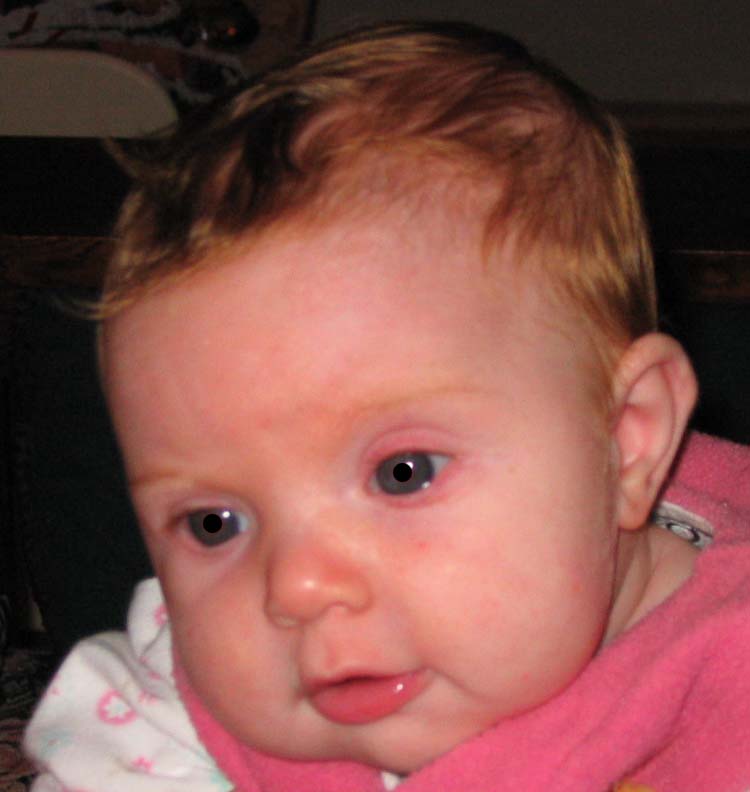
 Tresa, Me, Heather, Linda
taken a few months before Heather died
I found him seated on the edge of the bed holding Heather in one arm, the oxygen mask in the palm of his free hand. She’d always been afraid of the mask; she’d thrash in panic if you set it too close to her face. Years later, I understood why. The smell of the rubber is so noxious it suffocates. Mindful, Dad held the mask an inch or two from her mouth, precious oxygen escaping. At the sound of my voice he looked up, then gravely nodded to let me know I could come in and sit down beside them. The bed sank a little under my weight. Heather startled, she struggled to see me. I reached over and curled her all but lifeless blue fingers around my own. At the end of the bed, Mum paced. In front of me was the oxygen tank.
In the odd silence of tension and the quiet gasps of my sister dying, I became fascinated by the gauge needle slipping closer to the red empty mark. I gave Dad a running commentary. Finally, in uncharacteristic abruptness, he said, “Brenda, it would be better to pray than chatter.”
I instantly let go of Heather’s hand, shoved both of mine down between my legs, and bowed my head in agony. I’d been caught pretending she wasn’t dying. But she was. I did know this. And I knew that if she didn’t regain her breath within minutes, before the oxygen was gone, the sun would rise without my sister in its light. Frantically I prayed. I begged. I pleaded in panic as I watched the needle sink into the red zone, like the spinner in Shoots and Ladders settling on the line between six and one even as I, at last, sensed my sister relax. The hiss of the oxygen tank suddenly sputtered out. I jerked toward Heather. She’d fallen asleep.
“Daddy?”
He looked at me.
“She didn’t die, Daddy.”
She died two years later, while I slept.
I spend time on Heather because she informs both my writing and my faith. People used to criticize my parents for allowing my sisters and me front row seats to the drama of her short life and lonely death. Did they fear God’s impotence? True, my childish guilt over her ultimate death haunted me for years, but when a child sees God’s face in the mirror of pain, she knows God’s love. She knows he tempers the wind for the shorn lamb. And she knows she can trust Him. Even if she doesn’t understand Him.
And so I wrote, trying to understand. Not just in this first difficulty but in the many to follow: numerous moves; medical errors; poor health; a near-death experience from asthma; sexual molestation; my little brother’s broken neck, his paralysis; a bankrupt marriage. . .
Marriage was the darkest hour. Job’s friends rallied and drove me to despair. My doctors told me I would die and now God was the enemy, but my loyalty to Him tolled the bell. Though He slay, yet I will trust Him. . .
I actually began publishing in high school, a lonely girl who watched the world and wondered. I wrote from a troubled heart, my emotions raw and real. Then one day I married and emotion was silenced. I retreated deeply into myself. Denied expression and question, I held fast to a fading memory of God’s love reflected in my little sister’s pain.
And then one day, in the fullness of time I suppose and sick of Job’s friends no doubt, I turned to Job himself. “Behold, He will slay me; I have no hope,” he told his friends. Wait…he isn’t done. “But yet I will defend my ways to his face. And this will be my salvation.” How could I forget that I can shove my hands between my legs and bow my head in agony of mind and soul before the very throne of God and pray in a panic for life?
Shoreline Community College was offering a class called “Writing for Pleasure and Profit.” I picked up my pen and met God head on. In between, I wrote for my teacher and sold all six assignments. My father sent me four months pregnant with my third child to Billy Graham’s School of Christian Writing in St. Paul where Roger Palms began the conference by saying his prayer was not that any of us would learn how to publish but that we’d learn if God wanted us to write. An hour later, in Lois Walfrid Johnson’s nonfiction class, I found myself skewered to my chair by the sensation of a heated rod that went from the top of my head, down through my body, and into the seat. I could not move. Futilely I squirmed in the terrible discomfort as Lois read:
“Before I formed you in the womb, I knew you, and before you were born I consecrated you; I appointed you a prophet to the nations.”I went home in a daze. A week later Sherwood Wirt, editor emeritus of Billy Graham’s magazine, called me. He’d found one of my manuscripts and wanted to know if I could send something to Decision. And thus I began writing my way back to God; not the god of my marriage but the God of my childhood; a God of love, of joy. A God of mercy and grace. I sold everything I wrote. A year after my inevitable divorce, I sold my first book.Divorce thrust my three children and me into a world of poverty, abuse, oppression, disease, and despair--not so much ours but others. Divorce opened my eyes to what goes on outside the safety of white middle-class America; and I began to chafe at the restrictions imposed by the religious publishing world. I had things to say, that needed to be said, but I was to keep my notions to myself and deliver only what the “marketplace” warranted. So my writing, rather than helping me understand the tragic world around me instead cut me off from meaningful exploration of truth and honest emotion. I had three mouths to feed, and so buckled down. I churned out novels, articles, short stories, radio scripts, and supplemented our meager income, as Alice Walker put it, by selling apples on the street corner. I did this for years. Finally, frustration drove me back to school, where I could again have the freedom to delve and discover, and begin again to find my diminishing faith and voice.
Then I said, “Ah, Lord God! Behold, I do not know how to speak, for I am only a youth.”
But the Lord said to me, “Do not say, ‘I am only a youth;’ for to all to whom I send you you shall go, and whatever I command you you shall speak. Be not afraid of them, for I am with you to deliver you, says the Lord.”
Then the Lord put forth his hand and touched my mouth, and the Lord said to me. “Behold, I have put my words in your mouth…”
 I had identified a pattern. Denied honest expression in my writing, my faith would wither. I recovered both my voice and faith at Fairhaven College in 1988. The environment was ironically cynical, at times hostile, to western religion; yet I found it intoxicating, exhilarating, for I had an open road and unfettered feet. Professors plied me with books to read, reports to write, ideologies to dissect and rebuild. I worked them hard as I plowed through Jungian Psychology, Women’s Psychology, Women in History; as I explored patriarchal science through a feminist paradigm; as I studied the goddess before god; as I learned new words for old truths and struggled to articulate new faith. One that centered on Jesus, whose first mission after resurrection was to visit women who cried. A heady, exhilarating task in the tumbler of cynicism and agnosticism that ever honed and shaped me and, truth to tell, awarded me the first professional respect I’d ever known. I emerged with a contract from HarperCollins to write Taming the Dragons and entered graduate school with another contract to write the third novel in my Seattle Sweetbriar series, by now the bread-and-butter of my family’s existence.
 Taming the Dragons came out two years after I received my MA. But just weeks before the pub date my editor at Harper left. Taming was released an orphan. A bitter disappointment. The book remains in my mind as the greatest piece of literature and analysis I have ever written. Conceived in the years of my silence, born in the hallowed halls of academia (an alchemy of magic that drove me to my best), there was no one to nourish my project and so the book floundered. I’ve not found another publisher to reprint it. Wizards and fairy tales and stories of Ashtar? More “Christian fiction,” please.
I tried. But three more books and I was burned out. I turned to teaching at the community college, only to discover that 500 essays a quarter from students who couldn’t care less about words was cancer to what little was left of my creativity.
 Years ago I studied under Charles Johnson at the University of Washington, where I wrote a rough draft of my family’s experience at a Christian camp following Heather’s death. Last winter I pulled it out and rewrote the first chapter. I gave it to my youngest son. “You have to write this.” I tried it out on a friend. “This is your masterpiece.” I sent it back to my professor. “You are a wizardly writer. Your professionalism and skill,” Chuck e-mailed, “come singing off every page.” Perhaps this is the writing for which God skewered me to the chair?
I don’t know.
Frederick Buechner says truth can’t be stated; truth is the silence before the word. Truth can only be experienced. Poetry and art, he says, frame the silent truth. I am therefore applying to SPU so I can again delve and discover in the hallowed halls of academia; be nurtured in my writing and faith; and find a way to frame the silence of my life so that others experience the truth that I know. Truth I learned from the front row seat to the drama of short life and lonely death with all its answered and unanswered prayer. For whenever I pick up my pen I meet God in the silence of everything I cannot understand, I see him reflected in the mirror of pain I cannot explain. He tempers the wind and this I have come to understand is true.